DEF 14A: Definitive proxy statements
Published on April 30, 2026
UNITED STATES
SECURITIES AND EXCHANGE COMMISSION
Washington, DC 20549
SCHEDULE 14A
(Rule 14a-101)
INFORMATION REQUIRED IN PROXY STATEMENT
SCHEDULE 14A INFORMATION
Proxy Statement Pursuant to Section 14(a) of the
Securities Exchange Act of 1934
(Amendment No. )
Filed by the Registrant ☒
Filed by a Party other than the Registrant ☐
Check the appropriate box:
| Preliminary Proxy Statement | |||||
| Confidential, for Use of the Commission Only (as permitted by Rule 14a-6(e)(2)) | |||||
☒ | Definitive Proxy Statement | ||||
| Definitive Additional Materials | |||||
| Soliciting Material under §240.14a-12 | |||||
| (Name of Registrant as Specified in its Charter) | ||
| (Name of Person(s) Filing Proxy Statement, if Other Than the Registrant) | ||
Payment of Filing Fee (Check all boxes that apply):
☒ | No fee required. | ||||
| Fee paid previously with preliminary materials. | |||||
| Fee computed on table in exhibit required by Item 25(b) per Exchange Act Rules 14a-6(i)(1) and 0-11. | |||||
LETTER FROM CEO
April 30, 2026
Dear Fellow Stockholder,
As I reflect on 2025, I am encouraged by the meaningful progress we made across the Company. We broadened our customer base, advanced our technology, strengthened our operations, and delivered significantly improved financial results. Together, these outcomes reflect a more focused organization and a team deeply committed to our mission of making the world a safer place to live, work, learn, and play.
Executing with Discipline and Delivering Consistent Growth
In 2025, we executed with discipline. We welcomed nearly 250 new customers, grew our deployed base to over 8,000 active systems, and screened more than one billion visitors during the year—bringing total screenings since the launch of Evolv Express in 2019 to more than four billion visitors. On average, our customers used our technology to tag more than 500 firearms per day, underscoring the critical role Evolv plays in modern security operations.
Early in 2025, we restructured the business to sharpen our focus on our core competencies—weapon screening at entrances—while also reducing our overall cost structure. We also strengthened our executive leadership team with the addition of a new Chief Financial Officer, a new Chief Revenue Officer, a new Chief Marketing Officer, and a new Head of Supply Chain. Together, these actions aligned the organization around a more focused strategy and enabled us to set—and achieve—new financial goals for profitability and cash flow generation.
Financially, 2025 marked an important step forward as we continued building a more scalable and predictable business.
•Total revenue was $145.9 million, up 40% year over year, driven primarily by strong new customer acquisition, expansions within our customer base, higher unit deployment levels and a shift in our business model that brings more revenue per unit to the Company, as further described below.
•We ended the year with Annual Recurring Revenue (“ARR”) of $120.5 million, an increase of 21% year over year, reflecting continued demand across our core markets and expansion within our installed base.
•Adjusted EBITDA improved to $11.1 million for the full year—our first full year of positive Adjusted EBITDA—representing an improvement of more than $30 million compared to 2024.
•We exited the year with $69.0 million in cash, cash equivalents, and marketable securities, compared to $51.9 million at the end of 2024, reflecting the successful closing and partial draw on our new credit facility, as well as improved cash flow that included continued improvements in working capital management and cash collection.
Evolving Our Business Model for Long‑Term Value
One of the most important developments in 2025 was the continued evolution of our business model to better align our financial results with the long-term value we create for customers. We are a security-as-a-service company, offering customers two ways to access our technology: a full subscription model, in which Evolv retains ownership of the hardware, and a purchase subscription model, in which customers purchase the hardware while subscribing to our software and services under long-term contracts. In both cases, customers are entering into multiyear relationships that rely on our software, AI models, and services to operate effectively.
Beginning in mid‑2025, we transitioned purchase‑subscription orders sold through channel partners to a direct fulfillment model, with Evolv now providing both the hardware and subscription under a single commercial transaction. This change applies only to channel‑led purchase subscriptions and has no impact on direct sales or full‑subscription offerings. The shift - along with related pricing changes - improves the long‑term economics of each deployment by increasing total contract value and recurring revenue, strengthening cash generation, and enhancing customer lifetime value over the typical four‑year subscription contract.
Importantly, this evolution better positions us to serve a very large market opportunity. We estimate there are more than 700,000 public entryways across schools, hospitals, stadiums, workplaces, and other gathering places, only a small fraction of which utilize next generation security solutions today - and our evolved model makes it easier for customers to adopt and scale with us. Aligning our business model with this opportunity improves visibility, durability, and predictability as we grow, supported by the steps we took in 2025 to strengthen our contract manufacturing capabilities, production scalability, and supply chain efficiency.
A Differentiated Platform in an Evolving Technology Landscape
Much has been written about generative AI and its implications for software and software-as-a-service (“SaaS”) businesses. We are not a pure SaaS company. Our differentiation lies in our control of a full, end-to-end solution stack that tightly integrates proprietary hardware, sensors, data, software, and AI.
We design our own hardware, develop the software that runs on it, and develop proprietary AI models using unique, real world data generated by our deployed systems. Because our systems are cloud connected, we can evaluate and improve our models against real scans across diverse environments. This combination of deployed systems, proprietary data, and operational learning creates a defensible moat which we believe is very difficult to replicate.
We deliver this capability to customers as weapons detection as a service. That model supports long-term subscription relationships, recurring revenue, and increasing visibility through ARR and remaining performance obligation (“RPO”), while continuously improving the performance and reliability of the platform over time.
Advancing Innovation and Expanding Impact
Innovation remains foundational to our strategy. In 2025, we continued to innovate for enhanced detection accuracy, advanced threat localization capabilities, and improved visualization tools relied upon by operators in fast-moving environments. Adoption of Evolv eXpedite™, our autonomous AI-based bag screening solution, continued to grow across education, healthcare, and workplace settings where high-clutter conditions require new approaches. We also expanded functionality across the MyEvolv™ portal, mobile app, and cloud APIs to deliver deeper insights and more integrated workflows.
Across the places people gather, our impact continues to grow. In education, healthcare, sports and live entertainment, and workplaces, customers choose Evolv because we provide a layered, AI-driven approach to security that enhances safety while preserving the flow and experience essential to daily life. The work we do matters—not just in the threats detected, but in the confidence it brings to students, patients, employees, and communities.
The Path Ahead
As we move into 2026, our focus remains on execution and long-term value creation. We will continue to:
•Expand our leadership across key North American markets, including education, healthcare, sports, and emerging markets like industrial workplaces and office buildings.
•Invest in the ongoing advancement of Evolv Express, eXpedite, and our cloud-delivered intelligence capabilities.
•Build on early international traction as global demand for modern security solutions grows.
•Maintain disciplined operational execution and responsible cost management to support sustainable, profitable growth.
We enter the year with momentum, a stronger foundation, and a clear sense of purpose. I want to thank our employees, customers, partners, and stockholders for your continued trust and support. Together, we are building a company that not only delivers long-term value, but also helps make the world a safer place.
Sincerely,
John Kedzierski

President and Chief Executive Officer
Evolv Technologies Holdings, Inc.
LETTER FROM INDEPENDENT CHAIR
Dear Fellow Stockholder,
It is a privilege to serve as Chair of the Board of Directors of Evolv Technologies and to communicate directly with you. On behalf of the Board, I want to thank you for your continued support.
The Board remains deeply committed to providing robust, independent oversight as Evolv continues to grow its business and advances its mission to help make schools, hospitals, stadiums, workplaces, and many other gathering places safer.
Throughout 2025, the Board continued to have an active role in guiding Evolv through an important period of its evolution. We worked closely with our CEO John Kedzierski and the entire management team to enhance operational execution, internal controls, and strategic alignment around clear priorities to improve business and financial performance. These efforts reflect the Board’s focus on establishing a foundation for sustainable growth and long-term shareholder value creation.
The Board was encouraged in 2025 by the Company’s expansion of its recurring revenue base, operating results, and strengthened balance sheet. Evolv ended the year with $120.5 million in Annual Recurring Revenue, a 21% year‑over‑year increase, driven by strong new customer acquisition, expanding deployments, and solid renewals. The Company added nearly 250 customers for a total year-end customer count of 1,200 globally. Evolv finished 2025 by delivering its fifth consecutive quarter of positive Adjusted EBITDA, showing meaningful improvements in operating consistency and cost management. In addition, the Company exited the year with a strong balance sheet, supported by our new credit facility and more efficient use of cash and working capital.
The Board going forward will continue to emphasize execution, alignment, and performance. In doing so, the Board will continue to promote strong governance and proper risk management. Moreover, we will seek to have in place the structure, incentives, and controls, which coupled with a culture rooted in discipline and integrity, are designed to produce results and contribute to long‑term success.
The Board itself has evolved over the past 18 months as part of our efforts to enhance our effectiveness as we enter our next phase of growth. We have benefited from the addition of Richard Shapiro, who brings expertise in capital markets, finance, and public company governance. Richard was originally recommended by one of our stockholders, reflecting the constructive dialogue we value with our investor base. His expertise and perspectives have enhanced the Board’s oversight, stockholder engagement, and financial depth.
More recently, we welcomed Henrik Kühl to the Board. Henrik brings valuable insights and highly relevant experience at the nexus of physical security technologies and hardware‑enabled SaaS businesses, along with proficiency in corporate strategy, capital allocation, and finance. His service as an Audit Committee financial expert enhances the Board’s ability to oversee strategic risk, investment decisions, and financial matters. Henrik joined the Board shortly after the resignation of Bilal Zuberi, a long-tenured Board member with extensive experience in venture capital and with early-stage companies. We are grateful to Bilal for his vision, judgment, and contributions, which were instrumental in shaping Evolv especially during its formative years.
After many years of dedicated service on the Board, David Mounts-Gonzales and Mark Sullivan have expressed their preference not to be re‑nominated. Mr. Mounts-Gonzales and Mr. Sullivan will continue to serve on the Board through the opening of the polls at the Annual Meeting. The Board extends its deep gratitude to both Mr. Mounts-Gonzales and Mr. Sullivan for their unwavering commitment, thoughtful leadership, and the many valuable contributions they have made to the Company throughout their respective tenures.
Looking forward, the Board will work closely with management to position Evolv to realize its long-term potential as a growth-oriented, mission-based, technology company. The Board is encouraged by the progress made in 2025, and we are confident in Evolv’s future and excited about the opportunities ahead of us.
On behalf of the entire Board of Directors, we truly appreciate your ongoing support.
Sincerely,
Neil Glat
Chair of the Board of Directors of
Evolv Technologies Holdings, Inc.
Evolv Technologies Holdings, Inc.
Table of Contents
| Table of Contents | |||||

EVOLV TECHNOLOGIES HOLDINGS, INC.
500 Totten Pond Road, 4th Floor
Waltham, Massachusetts 02451
NOTICE OF ANNUAL MEETING OF STOCKHOLDERS
TO BE HELD THURSDAY, JUNE 18, 2026
The 2026 Annual Meeting of Stockholders (the “Annual Meeting”) of Evolv Technologies Holdings, Inc., a Delaware corporation (the “Company”), will be held at 10:00 a.m. eastern time on Thursday, June 18, 2026. The Annual Meeting will be a completely virtual meeting, which will be conducted via live webcast. You will be able to attend the Annual Meeting online and submit your questions during the meeting by visiting www.virtualshareholdermeeting.com/EVLV2026 and entering your 16-digit control number included in your Notice of Internet Availability of Proxy Materials, on your proxy card or on the instructions that accompanied your proxy materials. The Annual Meeting will be held for the following purposes:
•To elect Neil Glat and Richard Shapiro as Class II Directors to serve until the 2029 Annual Meeting of Stockholders, and until their respective successors shall have been duly elected and qualified;
•To approve, on an advisory (non-binding) basis, the compensation of our named executive officers (the “Say-on-Pay Vote”);
•To ratify the appointment of PricewaterhouseCoopers LLP as our independent registered public accounting firm for the fiscal year ending December 31, 2026;
•To transact such other business as may properly come before the Annual Meeting or any continuation, postponement, or adjournment of the Annual Meeting.
Holders of record of our Class A common stock as of the close of business on April 24, 2026 are entitled to notice of and to vote at the Annual Meeting, or any continuation, postponement or adjournment of the Annual Meeting. A complete list of such stockholders will be open to the examination of any stockholder for a period of ten days prior to the Annual Meeting for a purpose germane to the meeting during ordinary business hours at the Company’s principal offices or by sending an email to Rachel Roy, General Counsel and Secretary, at rroy@evolvtechnology.com stating the purpose of the request and providing proof of ownership of Company stock. The list of these stockholders will also be available on the bottom of your screen during the Annual Meeting after entering the 16-digit control number included on your Notice of Internet Availability of Proxy Materials, on your proxy card or on the instructions that accompanied your proxy materials. The Annual Meeting may be continued or adjourned from time to time without notice other than by announcement at the Annual Meeting.
It is important that your shares be represented regardless of the number of shares you may hold. Whether or not you plan to attend the Annual Meeting online, we urge you to vote your shares via the toll-free telephone number or over the Internet, as described in the enclosed materials. If you received a copy of the proxy card by mail, you may sign, date and mail the proxy card in the enclosed return envelope. Promptly voting your shares will ensure the presence of a quorum at the Annual Meeting and will save us the expense of further solicitation. Submitting your proxy now will not prevent you from voting your shares at the Annual Meeting if you desire to do so, as your proxy is revocable at your option.
By Order of the Board of Directors
Rachel Roy
General Counsel and Secretary
Waltham, Massachusetts
April 30, 2026
1
IMPORTANT NOTICE REGARDING THE AVAILABILITY OF PROXY MATERIALS FOR THE STOCKHOLDER MEETING TO BE HELD ON THURSDAY, JUNE 18, 2026
This Notice and Proxy Statement and our 2025 Annual Report to Stockholders are available at www.virtualshareholdermeeting.com/EVLV2026
2
EVOLV TECHNOLOGIES HOLDINGS, INC.
500 Totten Pond Road, 4th Floor
Waltham, Massachusetts 02451
PROXY STATEMENT SUMMARY
These proxy materials are being provided in connection with the solicitation by the Board of Directors of Evolv Technologies Holdings, Inc. of proxies to be voted at our Annual Meeting of Stockholders to be held on Thursday, June 18, 2026 (the “Annual Meeting”), at 10:00 a.m. eastern time, and at any continuation, postponement, or adjournment of the Annual Meeting. These proxy materials were first sent on or around April 30, 2026.
The Annual Meeting will be a completely virtual meeting, which will be conducted via live webcast. If you are a holder of record of shares of our Class A common stock, par value $0.001 per share (“Class A common stock”), as of the close of business on April 24, 2026 (the “Record Date”), you will be able to attend the Annual Meeting online and submit questions during the Annual Meeting by visiting www.virtualshareholdermeeting.com/EVLV2026 and entering your 16-digit control number included in your Notice of Internet Availability of Proxy Materials, on your proxy card or on the instructions that accompanied your proxy materials.
In this proxy statement, “Evolv”, “Company”, “we”, “us”, and “our” refer to Evolv Technologies Holdings, Inc.
3
Summary of Proposals
| Proposal | Board Recommendation | Reasons for Recommendation | Page | ||||||||
1.To elect Neil Glat and Richard Shapiro as Class II Directors to serve until the 2029 Annual Meeting of Stockholders, and until their respective successors shall have been duly elected and qualified. | FOR each director nominee | The Board of Directors (“Board”) and its Nominating and Corporate Governance Committee believe the Board nominees have the skills, experience, and backgrounds necessary to effectively monitor performance, provide oversight, and advise management on our long-term strategy. | |||||||||
2.To approve, on an advisory (non-binding) basis, the compensation of our named executive officers (the “Say-on-Pay Vote”) | FOR | Our executive compensation programs demonstrate our pay for performance philosophy and reflect the input of stockholders from our outreach efforts. | |||||||||
3.To ratify the appointment of PricewaterhouseCoopers LLP (“PwC”) as our independent registered public accounting firm for the fiscal year ending December 31, 2026. | FOR | Based on the Audit Committee’s assessment of PwC’s qualifications and performance, the Board believes that retention of PwC for the fiscal year ending December 31, 2026 is in our stockholders’ best interests. | |||||||||
4
Corporate Governance Highlights
Evolution in Corporate Governance Timeline
Evolv made numerous corporate governance changes and improvements in 2025.
July 2025 | •Refreshment of the Audit Committee Charter | |||||||
August 2025 | •New Disclosure Committee charter implemented •Disclosure governance framework operationalized •Refreshment of Code of Business Conduct and Ethics | |||||||
September 2025 | •Michael Ellenbogen resigns as Evolv’s Chief Innovation Officer, but continues to serve as a member of the Board. | |||||||
November 2025 | •Reviewed Board and committee self‑evaluation results •Reviewed Board skills matrix | |||||||
December 2025 | •Updated Nominating & Corporate Governance Committee Charter •Approved Executive Stock Ownership Guidelines | |||||||
February 2026 | •Resignation of Bilal Zuberi as member of the Board •Appointment of Henrik Kühl to Board and Audit Committee | |||||||
Governance Best Practices
The following is a summary of our corporate governance practices, which we regularly evaluate and update through stockholder engagement and evolving practices.
Board Practices | |||||||||||
P Board refreshment, including appointment of two new directors since the beginning of 2025 | P Director attendance of at least 75% of Board and committee meetings | ||||||||||
P Annual board self-evaluation process overseen by Nominating and Corporate Governance Committee | P External advisor partnerships to holistically evaluate Board composition and effectiveness | ||||||||||
P Ongoing evaluation of Board skills, experiences and composition to support the Company’s long-term strategy and oversight needs. | P Anti-hedging and pledging policy | ||||||||||
P Robust clawback policy | P Stock ownership guidelines for non-employee directors | ||||||||||
Independent Oversight | |||||||||||
P Separate CEO and Chair | P 8 out of 10 directors are independent | ||||||||||
P Independent Chair | P 100% independent directors on Audit, Compensation and Nominating and Corporate Governance Committees | ||||||||||
P Dedicated Investment Committee tasked with overseeing investment strategy and capital allocation | P Regular executive sessions for independent directors without non-independent directors or management present | ||||||||||
P Chief Compliance Officer reports to the Audit Committee | P Compensation Committee retains an independent compensation consultant | ||||||||||
5
Stockholder Rights | |||||||||||
P No poison pill in place | P Robust stockholder engagement process (see “Stockholder Engagement and Outreach” section below) | ||||||||||
P One vote for each share and no non-voting stock | P Annual “Say-on-Pay” vote | ||||||||||
Business Highlights
Evolv Technology is a leading security technology company pioneering AI-based solutions designed to create safer experiences. Our mission is to transform security to create a safer world to live, work, learn, and play. Our products are designed to transform human security to help make a safer, faster, and better experience for the world’s most iconic venues and companies as well as schools, hospitals, and public spaces, using industry leading artificial intelligence (“AI”)-powered screening and analytics.
2025 was a transformative year for Evolv, which achieved strong financial and operational results.
| Financial Highlights | •We reported total revenue of $145.9 million in 2025, up 40% from 2024, reflecting strong new customer growth, expanded deployments from our existing customers, and the shift we made in mid-2025 to directly fulfilling the hardware portion of purchase subscription orders. | ||||
•Annual Recurring Revenue (ARR) rose 21% to $120.5 million from $99.4 million in 2024.1 | |||||
•Net loss narrowed to ($33.1) million, or ($0.20) per diluted share, compared to ($54.0) million, or ($0.34) in 2024. | |||||
•Adjusted EBITDA improved to $11.1 million from ($21.0) million in 2024, highlighting greater leverage in our business model.2 | |||||
•We ended 2025 with $69.0 million in cash, cash equivalents, restricted cash, and marketable securities, maintaining a solid financial position. | |||||
| Operational Highlights | •We welcomed nearly 250 new customers across key end markets including education, healthcare, professional sports, and industrial workplaces. | ||||
•We expanded the number of multi-year subscriptions of Evolv Express®, our AI-powered security screening system, and Evolv eXpedite, our autonomous AI-powered bag screening solution, from approximately 6,100 in 2024 to over 8,000 by year-end 2025. | |||||
•Our customers used Evolv Express and Evolv eXpedite to tag over 600,000 weapons, underscoring the vital role our technology plays in safeguarding high-traffic environments. | |||||
1 Please see Appendix A for how ARR is defined.
2 Please see Appendix A for how Adjusted EBITDA is defined and a reconciliation of Adjusted EBITDA with net income (loss) the most comparable GAAP measure.
6
Stockholder Engagement and Outreach
We believe that regular, constructive engagement with our stockholders is an important element of effective corporate governance. We value stockholder perspectives and consider their views as part of the Board’s and management’s ongoing evaluation of board composition, corporate governance practices, and executive compensation.
As part of this commitment, during the fall and winter of 2024–2025 we conducted an extensive stockholder engagement program, through which we reached out to a broad group of institutional stockholders representing a significant portion of our outstanding shares to solicit feedback on a range of topics, including board composition, executive compensation, and peer group considerations. These engagements included meetings and conference calls with institutional investors and featured participation by our Board Chair, the Chair of the Compensation Committee, and members of senior management, including representatives from legal, finance, investor relations, and human resources.
While we did not conduct a separate, formal off‑season engagement program during the 2025–2026 period, we continued to maintain an open and ongoing dialogue with our stockholders throughout the year. Feedback received through these interactions was shared with the Board and its committees, as appropriate, and was considered as part of the Board’s deliberations and decision‑making processes.
We have a demonstrated history of thoughtfully considering stockholder input and, when appropriate and in the best interests of the Company and its stockholders, implementing changes that reflect that feedback. We expect to continue this approach going forward and remain committed to engaging with our stockholders and evolving our governance and compensation practices over time in response to constructive input and changing circumstances.
7
Fiscal 2025 Executive Compensation Program
The following table provides information regarding the key elements of our fiscal year 2025 executive compensation program, which applied to our Named Executive Officers (“NEOs”).
Element | Form | Objectives and Basis | ||||||
Base Salary | Cash | •Provides a competitive level of compensation to attract and retain highly qualified executives •Provides a degree of financial stability to executives | ||||||
Annual Cash Incentive Bonus | Cash | •Provides at-risk, variable cash pay opportunity for performance over one year •Annual incentive targets are designed to motivate executives to achieve or exceed short-term financial and strategic goals within appropriate risk parameters | ||||||
Long-Term Incentives | Market-based Stock Units (MSUs) (50%) | •Provides at-risk, variable equity-based pay opportunity for sustained operating performance •Vest based on the achievement of specified Company stock price goals over a three-year performance period | ||||||
Restricted stock units (RSUs) (50%) | •Long-term retention tool that vests over three years and aligns interests of executives with those of stockholders and promotes long-term value creation for stockholders | |||||||
The table below includes a detailed summary of the targets underlying our 2025 annual cash incentive bonus program and achievement against those targets:
| Metric | Weighting | Threshold (75% Funding) | Target (100% Funding) | Maximum(1) (150% Funding) | 2025 Result | Achievement (%) | ||||||||||||||
Revenue | 40% | $127M | $133M | $139M | $145.9M | 60% | ||||||||||||||
Free Cash Flow(1) | 30% | $0M | $0.4M | $0.8M | $1.0M | 45% | ||||||||||||||
Adjusted EBITDA | 30% | $5.6M | $9.4M | $11.2M | $11.1M | 43% | ||||||||||||||
| Total Achievement | 147.5% | |||||||||||||||||||
(1)Quarterly Rolling Average — calculation includes changes in cash used for operating activities, excluding inventory and including changes in capitalized research and development costs
See “2025 Executive Compensation Program Highlights” on page 28 for more information on our fiscal year 2025 executive compensation program.
PROPOSAL 1: ELECTION OF DIRECTORS
At the Annual Meeting, two (2) Class II Directors are nominated to be elected by our stockholders to hold office until the Annual Meeting of Stockholders to be held in 2029 and until each such director’s respective successor is elected and qualified or until each such director’s earlier death, resignation or removal.
We currently have ten (10) directors on our Board. The Board has nominated Neil Glat and Richard Shapiro for election as Class II Directors at the Annual Meeting who have served on our Board since 2021 and 2025, respectively.
As set forth in our Second Amended and Restated Certificate of Incorporation, the Board is currently divided into three classes with staggered, three-year terms. At each annual meeting of stockholders, the successors to directors whose terms then expire will be elected to serve from the time of election and qualification until the third annual meeting following election.
8
The current class structure is as follows:
•Class I, whose term will expire at the 2028 Annual Meeting of Stockholders;
•Class II, whose term will expire at the 2026 Annual Meeting of Stockholders and, if reelected, whose subsequent term will expire at the 2029 Annual Meeting of Stockholders; and
•Class III, whose current term will expire at the 2027 Annual Meeting of Stockholders.
Our Second Amended and Restated Certificate of Incorporation and Amended and Restated Bylaws provide that the authorized number of directors may be changed from time to time by the Board. Our directors may be removed only for cause by the affirmative vote of the holders of at least two-thirds (66 and 2∕3%) of our outstanding voting stock entitled to vote in the election of directors.
In the event that any of Neil Glat and Richard Shapiro should become unable to serve, or for good cause will not serve, as a director, the discretionary authority provided in the enclosed proxy will be exercised to vote for a substitute candidate designated by the Board, unless the Board chooses to reduce its own size. The Board has no reason to believe that any of these directors will be unable to serve if elected and each director has consented to being named in this proxy statement and to serving if elected.
Recommendation of the Board of Directors
 | The Board of Directors unanimously recommends a vote FOR the election of each of the below Class II Director nominees. | ||||
Nominees For Class II Director (terms to expire at the 2029 Annual Meeting)
The current members of the Board who are also nominees for election to the Board as Class II Directors are as follows:
| Name | Age | Served as a Director Since | Position with Evolv | |||||||||||||||||
Neil Glat | 58 | 2021 | Director | |||||||||||||||||
Richard Shapiro | 55 | 2025 | Director | |||||||||||||||||
The principal occupations and business experience, for at least the past five years, of each Class II Director are as follows:
Neil Glat
Neil Glat has extensive operating and strategic experience in sports, entertainment, media, and hospitality. During his more than 25 years in combined tenures at the New York Jets, the National Football League, SPORTFIVE, and professional service firms, Mr. Glat has consistently focused on, among other things, driving revenue growth, increasing consumer engagement, identifying new businesses, encouraging innovation, developing forward-looking strategies, and executing strategic transactions and deals.
Mr. Glat has been a director on our Board since July 2021 and Chairman of our Board since November 2023. Mr. Glat has been the Managing Member of NDG Strategies, LLC, a Florida limited liability company, which provides strategic advice to sports, media, and technology businesses and private equity firms since 2025. He previously provided similar services through NG Strategies, a New York limited liability company that was dissolved at the end of 2025. He was appointed in December 2021 as Co-President, Americas for SPORTFIVE, a global sports, entertainment, and marketing agency, and remained with SPORTFIVE until February 2024. From April 2012 through August 2019, Mr. Glat served as President of the New York Jets, and, from September 2019 to March 2020, he was a Senior Advisor to the New York Jets. Prior to that, Mr. Glat was a senior executive at the National Football League for 15 years, where he oversaw corporate development and strategy. Mr. Glat has previous experience in management consulting at McKinsey & Company and investment banking at Dillon, Read & Co. Mr. Glat also previously was an Operating Advisor for Arctos Sports Partners, a
9
private equity platform focused on the professional sports industry, and currently serves as a Venture Advisor to Lightscape Partners, an AI-focused venture capital platform.
Mr. Glat recently joined the Board of Daktronics (NASDAQ: DAKT), the leading U.S.-based designer and manufacturer of dynamic video communication displays and control systems, in September 2025. Mr. Glat previously served on the Board of fuboTV Inc. (NYSE: FUBO), an over-the-top streaming content distributor, from March 2024 until the completion of its merger with Disney’s Hulu + Live TV business in October 2025. He also was previously on the Board of ASM Global, a privately-held company which is the world’s largest stadium, arena, convention center, and venue management company, from October 2019 until it was sold in August 2024. Mr. Glat previously served on the Boards of NewHold Investment Corp. I from July 2020 to July 2021 and NewHold Investment Corp. II from October 2021 to April 2023, both of which were publicly-traded SPACs. Since 2025, Mr. Glat joined advisory boards for NewHold Investment Corp III (NASDAQ: NHIC) and NewHold Investment Corp IV (NASDAQ: NHIV), other publicly-traded SPACs. In addition, Mr. Glat serves on many philanthropic boards.
Mr. Glat earned a Bachelor of Sciences in Economics from The Wharton School at the University of Pennsylvania and a Juris Doctor from Harvard Law School. We believe that Mr. Glat is qualified to serve on Evolv’s Board based on his extensive experience in sports and other relevant industries, on public and private company boards, and in leadership, strategic, and operating positions.
Richard Shapiro
Richard Shapiro has been a director on our Board since February 2025. He is currently Founder and Chief Investment Officer of the family office, Ridge Run Partners LLC. Previously, Mr. Shapiro twice served as a portfolio manager at Millennium Management, a global, diversified alternative investment firm, where he was focused on equity investments, from 2020 to 2021, and from 2007 to 2011. From 2011 to 2020, Mr. Shapiro was at Wexford Capital, a multi-strategy investment firm, where he became a firm Partner in 2014. While at Wexford, Mr. Shapiro served as Portfolio Manager and Co-Head of Equities and was also a member of Wexford’s Hedge Fund Investment Committee. Earlier in his career, he held various investment roles including Amaranth Advisors and Putnam Investments.
Mr. Shapiro currently serves on the Board of Orion Energy Systems (NASDAQ: OESX) and Elah Holdings (OTCMKTS: ELLH) and joined the Board of Falcon Copper, a private company, in April 2026. He previously served on the Board of Altus Power (NYSE: AMPS), where he was Chair of the Compensation Committee, until April 2025, when Altus was taken private by TPG. He also served on the Boards of BBQ Holdings (NASDAQ: BBQ; f/k/a Famous Dave’s (NASDAQ: DAVE)), where he was Chair of the Compensation Committee and member of the Nominating & Governance Committee.
Mr. Shapiro received an M.B.A. from Georgetown University and a B.S. in Business Administration from the University of Southern California. We believe Mr. Shapiro is qualified to serve on the Board based on his experience as a public company investor and director.
Continuing members of the Board of Directors:
Class I Directors (terms to expire at the 2028 Annual Meeting)
The current members of the Board who are Class I Directors are as follows:
| Name | Age | Served as a Director Since | Position with Evolv | |||||||||||||||||
| Kevin Charlton | 60 | 2021 | Director | |||||||||||||||||
John Kedzierski | 47 | 2024 | President, CEO and Director | |||||||||||||||||
Kimberly Sheehy | 61 | 2021 | Director | |||||||||||||||||
The principal occupations and business experience, for at least the past five years, of each Class I Director are as follows:
10
Kevin Charlton
Kevin Charlton has been a director on our Board since July 2021, and currently serves as Chairman of the Compensation and Investment Committees. Mr. Charlton is currently Chief Executive Officer of NewHold Investment Corp III (NASDAQ: NHIC) and NewHold Investment Corp IV (NASDAQ: NHIC), two special purpose acquisition corporations focused on the industrial technology sector. He previously served as the Chief Executive Officer of NewHold Investment Corp I, the special purpose acquisition corporation that merged with Evolv in 2021. Prior to NewHold Enterprises, Mr. Charlton spent his private equity career at JPMorgan (NYSE: JPM), Investcorp, and Macquarie (ASX: MQG). Before his career in private equity, Mr. Charlton was with McKinsey and Company in New York and NASA Headquarters in Washington, DC.
Mr. Charlton is also currently Chairman of American AllWaste, a private environmental services company. Mr. Charlton has been the Co-Chairman of NewHold Enterprises LLC since 2017 and has spent more than 25 years in principal investing. He has served on the Boards of six public companies and more than 25 private companies.
Mr. Charlton received his Bachelor’s degree in Aerospace Engineering cum laude from Princeton University in 1988, his Master of Science in Aerospace Engineering with Distinction from the University of Michigan in 1990, and his Master of Business Administration with Honors from the Kellogg School at Northwestern University in 1995. We believe that Mr. Charlton is qualified to serve on Evolv’s Board based on his broad private equity and public company experience.
John Kedzierski
John Kedzierski has been President and CEO of Evolv Technology since December 2024. He brings to Evolv significant experience leading high-growth security and technology businesses. Previously, he spent more than 23 years at Motorola Solutions, Inc. (“Motorola Solutions”), a leading safety and security products and service company, most recently as Senior Vice President of Global Enterprise Sales. Mr. Kedzierski was responsible for leading Motorola Solutions’ global sales efforts for all enterprise verticals. Prior to that role at Motorola Solutions, he was responsible for leading product management, research and development, sales and marketing for Motorola Solutions’ Video Security and Access Control business, where he helped Motorola Solutions become a global leader in physical security.
Mr. Kedzierski also served as a member of Evolv’s Board from January 2022 to November 2023, as a designee of Motorola Solutions.
Mr. Kedzierski holds a Bachelor of Science degree in Computer Engineering from the University of Illinois at Urbana-Champaign, and a Master of Business Administration from Northwestern University’s Kellogg School of Management. We believe that Mr. Kedzierski is qualified to serve on Evolv’s Board based on his broad experience working in security and technology.
Kimberly Sheehy
Kimberly Sheehy has been a director on our Board since July 2021. From March 2019 to May 2020, she was the Chief Financial Officer of ResMan LLC, a privately-owned software company providing software solutions to multi-family residential property managers. Previously, from April 2018 to March 2019, she served as Chief Financial Officer of Lori’s Gifts, Inc., a privately-owned retail company serving hospitals throughout the United States. From November 2015 to October 2017, Ms. Sheehy served as the Chief Financial Officer of StackPath, LLC, an edge computing platform provider, and from November 2012 to October 2015, Ms. Sheehy served as Chief Financial & Administrative Officer of CyrusOne Inc. (NASDAQ:CONE), a public high-growth real-estate investment trust specializing in engineering, building and managing data center properties. She has also held various senior finance roles at Cincinnati Bell Inc. (NYSE: CBB).
Ms. Sheehy serves on the Board of Directors and as the chair of the Audit Committee and member of the Compensation Committee and Nominating and Corporate Governance Committee of CVB Financial Corp (NASDAQ: CVBF). Ms. Sheehy previously served on the Board of Directors and as the Chair of the Audit Committee of Shift Technologies Inc. (NASDAQ: SFT) and Switch, Inc. (NASDAQ: SWCH).
Ms. Sheehy earned a Bachelor of Science degree in Accounting from the University of Cincinnati in 1989. Ms. Sheehy holds the designation of Certified Directorship (NACD.DC) from the National Association of Corporate Directors. In addition, Ms. Sheehy has been a Certified Public Accountant since 1990. We believe
11
that Ms. Sheehy is qualified to serve on Evolv’s board based on her extensive executive, managerial, accounting and public company experience.
Class III Directors (terms to expire at the 2027 Annual Meeting)
The current members of the Board who are Class III Directors are as follows:
| Name | Age | Served as a Director Since | Position with Evolv | |||||||||||||||||
| Michael Ellenbogen | 62 | 2021 | Director | |||||||||||||||||
Henrik Kühl | 46 | 2026 | Director | |||||||||||||||||
| Rajan Naik | 54 | 2023 | Director | |||||||||||||||||
The principal occupations and business experience, for at least the past five years of each Class III Director are as follows:
Michael Ellenbogen
Michael Ellenbogen has served as a director since July 2021. He was also our Chief Innovation Officer from July 2021 until September 5, 2025 and served as our Interim Chief Executive Officer and President from October 30, 2024 until December 16, 2024. Prior to that, Mr. Ellenbogen co-founded Legacy Evolv (as defined below) with Anil R. Chitkara in July 2013 and served as Legacy Evolv’s Head of Advanced Technology since January 2020. Prior to that, Mr. Ellenbogen served as Legacy Evolv’s Chief Executive Officer from August 2013 to January 2020. Mr. Ellenbogen is currently the Chief Executive Officer of Resolv Tools, a private company, and serves as a member of its board of directors and chair. Prior to co-founding Evolv, Mr. Ellenbogen was the founder, President and Chief Executive Officer of Reveal Imaging Technologies, an X-ray imaging systems company focusing on automated explosives detection, from 2002 to 2010. Prior to joining Reveal, Mr. Ellenbogen was the Vice President of Research & Development and Business Development of PerkinElmer Detection Systems, a provider of X-ray-based security technologies, from 1994 to 2002. During his 25-plus year career in the security industry, Mr. Ellenbogen has proven his expertise in product and business development, as well as stakeholder value creation. In addition, Mr. Ellenbogen is an inventor with over 20 awarded patents.
Mr. Ellenbogen received a Bachelor of Arts degree in Physics from Colgate University in 1986. We believe that Mr. Ellenbogen is qualified to serve on Evolv’s Board based on his broad technical background, including his experience as founder and officer of Evolv.
Henrik Kühl
Henrik Kühl joined our board in February 2026. He is an accomplished leader with over 25 years of experience in corporate development and strategy. He currently serves as Senior Vice President, Strategy & Corporate Development at Axon (NASDAQ: AXON), a global leader in connected public safety technologies. In this role, Mr. Kühl drives strategic growth and innovation, oversees mergers and acquisitions, facilitates minority investments, forms strategic partnerships, and optimizes capital allocation and structure. Before joining Axon in 2019, Mr. Kühl held senior operational and strategy leadership roles at IMAGE Skincare, a skin care products company, where he supported global expansion, and spent six years in the investment banking division at Goldman Sachs, advising on M&A, financings, and capital structure. Earlier in his career, he served as Director of Strategic Planning at Herbalife, a dietary supplement company.
Mr. Kühl earned an MBA in Finance and Marketing from the Kellogg School of Management at Northwestern University and a BA in Economics, Diplomacy & World Affairs from Occidental College. We believe that Mr. Kühl is qualified to serve on Evolv’s Board based on his leadership and expertise in corporate development and strategy.
Rajan Naik
Rajan Naik, Ph.D., has been a director on our Board since November 2023. He has served as Chief Strategy Officer for Motorola Solutions since 2016. He is responsible for the corporate strategy organization, mergers and acquisitions, venture capital portfolio and competitive and market intelligence. Prior to joining Motorola Solutions, Dr. Naik was the Chief Strategy Officer at Advanced Micro Devices, a leading global
12
semiconductor company, and before that was a partner in the technology practice at McKinsey & Company, a consulting company.
Dr. Naik has served on the board of directors for CSG Systems International Inc. (Nasdaq: CSG) since August 2018.
Dr. Naik earned a Bachelor of Science in Engineering from Cornell University and a Ph.D. in Engineering from the Massachusetts Institute of Technology. We believe that Dr. Naik is qualified to serve on Evolv’s Board based on his broad experience in strategy and technology as well as extensive M&A experience having led over 50 acquisitions in the physical safety and security ecosystems.
13
CORPORATE GOVERNANCE
General
Our Board has adopted Corporate Governance Guidelines, a Code of Business Conduct and Ethics, and charters for our Nominating and Corporate Governance Committee, Audit Committee, Compensation Committee, and Investment Committee to assist the Board in the exercise of its responsibilities and to serve as a framework for the effective governance of the Company. You can access our current committee charters, our Corporate Governance Guidelines, and our Code of Business Conduct and Ethics in the “Corporate Governance” section of the “Investors” page of our website located at www.evolvtechnology.com, or by writing to our Secretary at our offices at 500 Totten Pond Road, 4th Floor, Waltham, Massachusetts 02451.
Leadership of the Board
Our Amended and Restated Bylaws and Corporate Governance Guidelines provide our Board with flexibility to combine or separate the positions of Chairman of the Board and Chief Executive Officer in accordance with its determination that utilizing one or the other structure would be in the best interests of our Company. We currently have an independent Chairman of the Board and a majority of our Board is comprised of independent directors. Our Board believes that separation of the positions of Chairman and Chief Executive Officer reinforces the independence of the Board from management, creates an environment that encourages objective oversight of management’s performance and enhances the effectiveness of the Board as a whole. In addition, the Board believes the independent Chairman is well-positioned to act as a bridge between management and the Board, facilitating the regular flow of information. Among other duties, the independent Chairman may represent the Board in communications with stockholders and other stakeholders and provide input on the structure and composition of the Board. For these reasons, our Board has concluded that our current leadership structure is appropriate at this time.
However, our Board will continue to periodically review our leadership structure and may make such changes in the future as it deems appropriate. If, in the future, the Chairman of the Board is a member of management or does not otherwise qualify as independent, our Corporate Governance Guidelines provide for the appointment by the independent directors of a Lead Director. The Lead Director’s responsibilities would include, but would not be limited to, presiding over all meetings of the Board at which the Chairman of the Board is not present, including any executive sessions of the independent directors, approving the Board’s meeting schedules and agendas, and acting as liaison between the independent directors of the Board and the Chief Executive Officer and the Chairman of the Board.
Director Independence
Evolv’s Board has determined that each of the following current non-employee members of the Board, and non-employee directors who served in 2025, are independent directors under the Nasdaq listing rules:
•Kevin Charlton
•Neil Glat
•Henrik Kühl (Appointed February 12, 2026)
•David Mounts-Gonzales
•Rajan Naik
•Richard Shapiro
•Kimberly Sheehy
•Mark Sullivan
•Bilal Zuberi (Resigned February 10, 2026)
14
The Board also determined that all Audit Committee, including Henrik Kühl, and Compensation Committee members satisfy the specific independence requirements required of such committees under the Nasdaq listing rules.
In making these independence determinations, our Board reviewed and discussed information provided by the directors and us with regard to each director’s business and personal activities and relationships as they may relate to us and our management.
In determining Mr. Naik was independent, the Board considered the fact that Mr. Naik does not have any direct involvement or material interest in our business relationship with Motorola Solutions and our relationship with Motorola Solutions would not interfere with his exercise of independent judgment in carrying out his responsibilities as a director.
There are no family relationships among any of our directors or executive officers.
Board's Role in Risk Oversight
Risk assessment and oversight are an integral part of our governance and management processes. Our Board encourages management to promote a culture that incorporates risk management into our corporate strategy and day-to-day business operations. Management discusses strategic and operational risks at regular management meetings and conducts specific strategic planning and review sessions during the year that include a focused discussion and analysis of the risks facing us. Throughout the year, senior management reviews these risks with the Board at regular Board meetings as part of management presentations that focus on particular business functions, operations or strategies, and presents the steps taken by management to mitigate or eliminate such risks. The Board reviews material risks facing the Company with the Audit Committee, senior management, and outside advisors on a regular basis.
Our Board does not have a standing risk management committee, but rather administers this oversight function directly through the Board as a whole, as well as through various standing committees of the Board that address risks inherent in their respective areas of oversight. The Board regularly reviews information regarding the Company’s key business risks.
Our Audit Committee is responsible for discussing the Company’s policies with respect to risk assessment and risk management, including guidelines and policies to govern the process by which the Company’s exposure to risk is handled.
Our Nominating and Corporate Governance Committee oversees the management of risk associated with the independence of the Board and potential conflicts of interest.
Our Compensation Committee oversees the management of risk relating to the Company’s incentive compensation and equity-based plans and arrangements.
Our Investment Committee oversees financial risk management, including cash management, liquidity, and investment strategy.
In addition to the committees of the Board, a management-led disclosure committee meets quarterly to identify any significant emerging risks and to align such risk identification and assessment with the Company’s existing disclosure controls and procedures. The disclosure committee then reports its findings and recommendations to the Audit Committee, which then reports to the Board.
Corporate Governance Guidelines
The Board has adopted Corporate Governance Guidelines to promote the effective functioning of the Board and its committees, to promote the interests of all stockholders, and to ensure a common set of expectations as to how the Board, its various committees, individual directors and management should perform their functions. The Corporate Governance Guidelines are posted on the Company’s website https://ir.evolvtechnology.com/governance/governance-documents, and are available in print upon request.
Director Candidates Selection and Evaluation
The Nominating and Corporate Governance Committee is primarily responsible for searching for qualified director candidates for election to the Board and filling vacancies on the Board. To facilitate the search process,
15
the Nominating and Corporate Governance Committee may solicit current directors and executives of the Company for the names of potentially qualified candidates. The Nominating and Corporate Governance Committee may also consult with outside advisors or retain search firms to assist in the search for qualified candidates, or consider director candidates recommended by our stockholders. Mr. Shapiro was initially recommended by one of the Company’s stockholders during the course of the Company’s recent stockholder engagement campaign. Once potential candidates are identified, the Nominating and Corporate Governance Committee reviews the backgrounds of those candidates, evaluates candidates’ independence from the Company and potential conflicts of interest and determines if candidates meet the qualifications desired by the Nominating and Corporate Governance Committee for candidates for election as a director.
In evaluating the suitability of individual candidates (both new candidates and current Board members), the Nominating and Corporate Governance Committee, in recommending candidates for election, and the Board, in approving (and, in the case of vacancies, appointing) such candidates, may take into account many factors, including: experience in corporate management, such as serving as an officer of a publicly held company; experience as a board member of another publicly held company; professional and academic experience relevant to the Company’s industry; the ability to exercise mature business judgment; leadership skills; experience in finance and accounting and/or executive compensation; the time and ability to prepare, participate in and attend Board meetings; and diversity of background and perspective, as well as specialized experience. In evaluating candidates, the Committee also considers the mix of skills, experience and attributes reflected in the Board’s director skills matrix, with the goal of maintaining an appropriate balance of capabilities aligned with the Company’s business and strategy. The Board evaluates each individual in the context of the Board as a whole, with the objective of assembling a group that can best perpetuate the success of the business and represent stockholder interests through the exercise of sound judgment using its diversity of experience in these various areas. In determining whether to recommend a director for re-election, the Nominating and Corporate Governance Committee may also consider the director’s past attendance at meetings and participation in and contributions to the activities of the Board.
Committees of the Board
Our Board has established four standing committees — Audit, Compensation, Nominating and Corporate Governance, and Investment. Each of the committees operates under a written charter that has been approved by our Board.
The members of each of the Board committees and committee Chairpersons are set forth in the following chart.
| Name | Audit | Compensation | Nominating and Corporate Governance | Investment | ||||||||||||||||||||||
| Kevin Charlton | Chairperson | Chairperson | ||||||||||||||||||||||||
| Neil Glat | X | X | ||||||||||||||||||||||||
David Mounts-Gonzales | X | |||||||||||||||||||||||||
| Henrik Kühl | X | |||||||||||||||||||||||||
Richard Shapiro | X | Chairperson | ||||||||||||||||||||||||
| Kimberly Sheehy | Chairperson | X | X | |||||||||||||||||||||||
Mark Sullivan | X | |||||||||||||||||||||||||
Audit Committee
Our Audit Committee is responsible for, among other things:
•appointing, compensating, retaining, evaluating, terminating and overseeing our independent registered public accounting firm;
•discussing with our independent registered public accounting firm their independence from management;
•reviewing, with our independent registered public accounting firm, the scope and results of their audit;
16
•approving all audit and permissible non-audit services to be performed by our independent registered public accounting firm;
•overseeing the financial reporting process and discussing with management and our independent registered public accounting firm the quarterly and annual financial statements that we file with the SEC;
•overseeing our financial and accounting controls and compliance with legal and regulatory requirements;
•reviewing our policies on risk assessment and risk management, including with respect to financial risks and cybersecurity risks;
•reviewing related person transactions; and
•establishing procedures for the confidential anonymous submission of concerns regarding questionable accounting, internal controls or auditing matters.
The Audit Committee charter is available on our website at https://ir.evolvtechnology.com/governance/governance-documents. The members of the Audit Committee are Kimberly Sheehy, David Mounts-Gonzales, Henrik Kühl, and Richard Shapiro. Kimberly Sheehy serves as the Chairperson of the committee.
Each member of our Audit Committee meets the requirements for financial literacy under the applicable Nasdaq rules, as determined by our Board. In addition, our Board has determined that Ms. Sheehy qualifies as an “audit committee financial expert,” as such term is defined in Item 407(d)(5) of Regulation S-K, and under the similar Nasdaq rules requiring that the Audit Committee have a financially sophisticated member.
The Audit Committee met 10 times in 2025.
Compensation Committee
Our Compensation Committee is responsible for, among other things:
•reviewing and approving or making recommendations to our Board regarding the compensation of our Chief Executive Officer and other executive officers;
•reviewing and approving or making recommendations to our Board regarding our incentive compensation and equity-based plans, policies and programs;
•reviewing and approving all employment agreement and severance arrangements for our executive officers;
•reviewing and making recommendations to our Board regarding the compensation of our directors; and
•retaining and overseeing any compensation consultants.
The Compensation Committee’s charter is available on our website at www.evolvtechnology.com.
The Compensation Committee may delegate its authority under its charter to one or more subcommittees as it deems appropriate from time to time. The Compensation Committee may also delegate to an officer the authority to grant equity awards to certain employees, as further described in its charter and subject to the terms of our equity plans.
The members of our Compensation Committee are Kevin Charlton, Kimberly Sheehy, and Mark Sullivan. Kevin Charlton serves as the Chairperson of the Compensation Committee. Each member of the Compensation Committee qualifies as an independent director under Nasdaq’s heightened independence standards for members of a compensation committee and as a “non-employee director” as defined in Rule 16b-3 of the Exchange Act.
The Compensation Committee met 5 times in 2025.
Nominating and Corporate Governance Committee
Our Nominating and Corporate Governance committee is responsible for, among other things:
•identifying individuals qualified to become members of our Board, consistent with criteria approved by our Board;
•overseeing succession planning for our Chief Executive Officer and other executive officers;
17
•periodically reviewing our Board’s leadership structure and recommending any proposed changes to our Board;
•overseeing an annual evaluation of the effectiveness of our Board and its committees; and
•developing and recommending to our Board a set of corporate governance guidelines.
The Nominating and Corporate Governance Committee charter is available on our website at https://ir.evolvtechnology.com/governance/governance-documents. The members of our Nominating and Corporate Governance Committee are Richard Shapiro, and Neil Glat. Richard Shapiro serves as the Chairperson of the Nominating and Corporate Governance Committee. Bilal Zuberi also served on the Nominating and Corporate Governance Committee during 2025. The Nominating and Corporate Governance Committee has the authority to consult with outside advisors or retain search firms to assist in the search for qualified candidates or consider director candidates recommended by our stockholders.
The Nominating and Corporate Governance Committee met 4 times in 2025.
Investment Committee
Our Investment Committee was established in March 2023 and is responsible for, among other things:
•Overseeing policies, practices and assessments relating to our (a) cash management and liquidity, (b) development and implementation of investment strategies for cash, cash equivalents and related assets, including providing input to management and the Board on our selection of depository banking facilities, (c) financial condition and outlook, and (d) strategies, policies, and programs related to financial risk management, including any capital expenditure plans and international hedging strategies;
•Providing input to management and the Board on the Company’s capital structure in relation to both equity and debt; and
•Providing input to management and the Board on financing structures and plans for potential mergers, acquisitions and other types of business combinations.
The Investment Committee charter is available at our website at https://ir.evolvtechnology.com/governance/governance-documents. The members of the Investment Committee are Kevin Charlton, Neil Glat, and Kimberly Sheehy. Kevin Charlton serves as the Chairperson of the Investment Committee.
The Investment Committee met 6 times in 2025.
Attendance by Members of the Board of Directors at Meetings
Our Board held 11 meetings during the fiscal year ended December 31, 2025. During the fiscal year ended December 31, 2025, each director attended 75% or more of the aggregate of (i) all meetings of the Board and (ii) all meetings of committees on which the director served for the period in which he or she served as a director.
Under our Corporate Governance Guidelines, which are available on our website at https://ir.evolvtechnology.com/governance/governance-documents, a director is expected to spend the time and effort necessary to properly discharge his or her responsibilities. Accordingly, a director is expected to regularly prepare for and attend meetings of the Board and all committees on which the director sits (including separate meetings of the independent directors), with the understanding that, on occasion, a director may be unable to attend a meeting. A director who is unable to attend a meeting of the Board or a committee of the Board is expected to notify the Chairman of the Board or the Chairman of the appropriate committee in advance of such meeting, and, whenever possible, participate in such meeting via teleconference in the case of an in-person meeting. We do not maintain a formal policy regarding director attendance at the Annual Meeting; however, it is expected that, absent compelling circumstances, directors will attend. Ten of our then-incumbent directors attended our annual meeting of stockholders held in 2025.
Communications from Stockholders
The Board will give appropriate attention to written communications that are submitted by stockholders and will respond if and as appropriate. Our Investor Relations team is primarily responsible for monitoring communications from stockholders and for providing copies or summaries to the directors as it considers appropriate.
18
Communications are forwarded to all directors if they relate to important substantive matters and include suggestions or comments that our Secretary and Chairman of the Board consider to be important for the directors to know. In general, communications relating to corporate governance and long-term corporate strategy are more likely to be forwarded than communications relating to ordinary business affairs, personal grievances and matters as to which we tend to receive repetitive or duplicative communications. Stockholders who wish to send communications on any topic to the Board should address such communications to the Board in writing: c/o Investor Relations, Evolv Technologies Holdings, Inc., 500 Totten Pond Road, 4th Floor, Waltham, Massachusetts 02451.
Code of Business Conduct and Ethics
We have a written Code of Business Conduct and Ethics that applies to our directors, officers and employees, including our principal executive officer, principal financial officer, principal accounting officer or controller, or persons performing similar functions. We have posted a current copy of the Code of Business Conduct and Ethics on our website, https://ir.evolvtechnology.com/governance/governance-documents, in the “Investors” section under “Corporate Governance.” In addition, we intend to post on our website all disclosures that are required by law or the rules of Nasdaq concerning any amendments to, or waivers from, any provision of the Code of Business Conduct and Ethics, within four business days. We granted no waivers in fiscal 2025.
Insider Trading Policy
Our Board has adopted an Insider Trading Compliance Policy , which applies to all of our directors, officers and employees and governs the purchase, sale, and other disposition of the Company’s securities. We believe this policy is reasonably designed to promote compliance with insider trading laws, rules, and regulations, and the exchange listing standards applicable to Evolv. The full text of our Insider Trading Compliance Policy is filed as Exhibit 19.1 to the Company’s Annual Report on Form 10-K for the year ended December 31, 2024.
Anti-Hedging and Pledging Policy
In addition to mandating compliance with the securities laws, our Insider Trading Compliance Policy prohibits our directors, officers and employees and any entities they control from purchasing financial instruments such as prepaid variable forward contracts, equity swaps, collars, exchange funds and other derivative or monetization instruments, or otherwise engaging in transactions that hedge or offset, or are designed to hedge or offset, any decrease in the market value of the Company’s equity securities, including transactions that allow the holder to lock in the value of Company securities, or that may cause an officer, director, or employee to no longer have the same objectives as the Company’s other stockholders except as otherwise pre-approved by the Audit Committee of our Board in each instance. Our Insider Trading Compliance Policy also prohibits the pledging of Company securities as collateral for any loans, including any margin loans, except as otherwise pre-approved by the Audit Committee of our Board in each instance. In addition, our Insider Trading Compliance Policy prohibits short sales of the Company’s securities as well as puts, calls or other derivative securities involving the Company’s equity securities.
19
2025 Director Compensation
Our Board adopted, and our stockholders approved, a non-employee director compensation program, which was updated in July 2023 (the “Director Compensation Policy”). In April 2025, the Compensation Committee reviewed and approved the compensation program for our non‑employee directors for fiscal year 2025, with no changes from the program approved for fiscal year 2024. The material terms of the Director Compensation Policy are summarized below. Each non-employee director will be paid cash compensation as set forth below. All amounts for service as a chairperson of the Board or a committee thereof are in addition to the amount for service as a member of our Board. Annual cash retainers will be paid in quarterly installments in arrears and will be pro-rated for any partial calendar quarter of service.
Director | Annual Retainer | |||||||
Member of the Board | $ | 40,000 | ||||||
Chair of the Board | $ | 40,000 | ||||||
| Audit Committee Chair | $ | 20,000 | ||||||
| Audit Committee Member | $ | 8,000 | ||||||
| Compensation Committee Chair | $ | 12,000 | ||||||
| Compensation Committee Member | $ | 5,000 | ||||||
| Nominating and Corporate Governance Committee Chair | $ | 10,000 | ||||||
| Nominating and Corporate Governance Committee Member | $ | 5,000 | ||||||
| Investment Committee Chair | $ | 10,000 | ||||||
| Investment Committee Member | $ | 5,000 | ||||||
An eligible director who is serving on the Board as of the date of the annual meeting of Evolv’s stockholders each calendar year will automatically be granted, on such annual meeting date, a RSU award with a value of $155,000 (each, an “Annual Grant”). Each Annual Grant will vest in full on the earlier to occur of (A) the first anniversary of the applicable grant date and (B) the date preceding the date of the next annual meeting following the grant date, subject to such eligible director’s continued service through the applicable vesting date.
Each non-employee director who is initially elected or appointed to the Board on any date other than the date of an annual meeting of stockholders, will automatically be granted, an Annual Grant on the date of such director’s initial election or appointment, which will be prorated based on the number of days that have elapsed since the previous annual meeting of stockholders.
Each Annual Grant will vest in full upon a change in control of our company (as defined in the Company’s 2021 Incentive Award Plan). Compensation under our Director Compensation Policy will be subject to the annual limit on non-employee director compensation set forth in the Company’s 2021 Incentive Award Plan.
The following table sets forth the compensation earned by our non-employee directors during 2025:
| Name | Fees Earned or Paid in Cash ($) | Stock Awards ($)(1) | Total ($) | |||||||||||||||||
| Kevin Charlton | (2) | $ | 69,667 | $ | 154,997 | $ | 224,664 | |||||||||||||
Michael Ellenbogen | (3) | $ | 12,826 | $ | — | $ | 12,826 | |||||||||||||
| Neil Glat | (2) | $ | 90,000 | $ | 154,997 | $ | 244,997 | |||||||||||||
| David Mounts-Gonzales | (2) | $ | 52,792 | $ | 154,997 | $ | 207,789 | |||||||||||||
| Rajan Naik | (4) | $ | — | $ | — | $ | — | |||||||||||||
Merline Saintil | $ | 2,417 | $ | — | $ | 2,417 | ||||||||||||||
| Richard Shapiro | (5) | $ | 43,600 | $ | 204,681 | $ | 248,281 | |||||||||||||
| Kimberly Sheehy | (2) | $ | 70,000 | $ | 154,997 | $ | 224,997 | |||||||||||||
| Mark Sullivan | (6) | $ | 45,000 | $ | 179,994 | $ | 224,994 | |||||||||||||
Bilal Zuberi | (2) | $ | 44,792 | $ | 154,997 | $ | 199,789 | |||||||||||||
___________________
20
(1)Amounts reflect the full grant-date fair value of stock awards granted during 2025 computed in accordance with ASC Topic 718, rather than the amounts paid to or realized by the named individual. We provide information regarding the assumptions used to calculate the value of all stock awards made to our directors in Notes 2 and 15 to the consolidated financial statements included in our Annual Report on Form 10-K for the fiscal year ended December 31, 2025. As of December 31, 2025, our non-employee directors held the following number of unvested RSUs:
Name | Unvested RSUs (#) | ||||
Kevin Charlton | 27,050 | ||||
Michael Ellenbogen | — | ||||
Neil Glat | 27,050 | ||||
David Mounts-Gonzales | 27,050 | ||||
Rajan Naik | — | ||||
Richard Shapiro | 27,050 | ||||
Kimberly Sheehy | 27,050 | ||||
Mark Sullivan | 27,050 | ||||
Bilal Zuberi | 27,050 | ||||
(2)During the year ended December 31, 2025, Mr. Charlton, Mr. Glat, Mr. Mounts-Gonzales, Ms. Sheehy, and Mr. Zuberi were each granted 27,050 RSUs.
(3)During the year ended December 31, 2025, Mr. Ellenbogen became eligible to receive compensation as a non‑employee director following his resignation as Chief Innovation Officer, effective September 5, 2025. Mr. Ellenbogen did not receive any compensation as a non‑employee director during 2025. Compensation earned by Mr. Ellenbogen in his capacity as Chief Innovation Officer was disclosed separately and is not included in this table.
(4)During the year ended December 31, 2025, Mr. Naik waived compensation for his role as a non-employee director.
(5)During the year ended December 31, 2025, Mr. Shapiro was granted 39,565 RSUs, which consisted of 12,515 RSUs upon his appointment to the Board and 27,050 RSUs as part of the Annual Grant.
(6)During the year ended December 31, 2025, Mr. Sullivan was granted 7,575 RSUs pursuant to an advisory agreement and 27,050 RSUs as part of the Annual Grant.
Compensation Committee Interlocks and Insider Participation
No member of the Compensation Committee was, at any time during fiscal year 2025 or at any other time, an officer or employee of the Company, and no member of this committee had any relationship with the Company requiring disclosure under Item 404 of Regulation S-K under the Exchange Act. No executive officer of the Company has served on the Board or compensation committee of any other entity that has or has had one or more executive officers who served as a member of the Compensation Committee during fiscal year 2025.
Director Stock Ownership Guidelines
Under the Company’s Non-Employee Director Stock Ownership Guidelines, each non-employee director is required to own or acquire, within five years of his or her initial election or appointment to the Company’s Board, shares of common stock of the Company having a market value of at least five times (5x) the annual cash retainer for serving as a director of the Company and to maintain such ownership level at all times during his or her tenure.
As of April 21, 2026, each non-employee director was in compliance with the minimum holding requirement under the Company’s Non-Employee Director Stock Ownership Guidelines or remained within the applicable five‑year phase‑in period to achieve compliance.
PROPOSAL 2: APPROVAL OF, ON AN ADVISORY (NON-BINDING) BASIS, THE SAY-ON-PAY VOTE
Pursuant to Section 14A of the Exchange Act, we request that our stockholders cast a non-binding, advisory vote to approve the compensation of our named executive officers identified in the section titled “Executive
21
Compensation” set forth below in this proxy statement. This proposal, commonly known as a “say-on-pay” proposal, gives our stockholders the opportunity to express their views on our named executive officers’ compensation.
Accordingly, we ask our stockholders to vote “FOR” the following resolution at the Annual Meeting:
“RESOLVED, that the Company’s stockholders approve, by a non-binding advisory vote, the compensation of the named executive officers, as disclosed in the Company’s Proxy Statement for the 2026 Annual Meeting of Stockholders pursuant to the compensation disclosure rules of the Securities and Exchange Commission, including the compensation tables and narrative discussion.”
We believe that our compensation programs and policies for the year ended December 31, 2025 were an effective incentive for the achievement of our goals, aligned with stockholders’ interests, and worthy of stockholder support. Additional details concerning how we structure our compensation programs to meet the objectives of our compensation program are provided in the section titled “Executive Compensation” set forth below in this proxy statement.
This vote is merely advisory and will not be binding upon us, our Board or our Compensation Committee, nor will it create or imply any change in the duties of us, our Board or our Compensation Committee. The Compensation Committee will, however, take into account the outcome of the vote when considering future executive compensation decisions. The Board values constructive dialogue on executive compensation and other significant governance topics with our stockholders and encourages all stockholders to vote their shares on this important matter.
The Company’s current policy is to hold an advisory vote on the compensation of our named executive officers each year, and we expect to hold another advisory vote with respect to executive compensation at the 2027 annual meeting of stockholders.
Recommendation of the Board of Directors
 | The Board of Directors unanimously recommends a vote FOR the approval of, on an advisory (non-binding) basis, the Say-on-Pay Vote. | ||||
EXECUTIVE OFFICERS
The following table identifies our current executive officers, determined based on Rule 3b-7 under the Exchange Act. Our named executive officers are a separate group determined under the SEC’s executive compensation disclosure rules applicable to smaller reporting companies. Not all executive officers are NEOs, and, depending on compensation levels in a given year, not all NEOs are necessarily executive officers:
| Name | Age | Position | ||||||||||||
| John Kedzierski | (1) | 47 | Chief Executive Officer, President, and Director | |||||||||||
| George C. Kutsor | (2) | 52 | Chief Financial Officer | |||||||||||
| Anil Chitkara | (3) | 58 | Co-Founder and Chief Growth Officer | |||||||||||
Robert Marshall | (4) | 54 | Chief Revenue Officer | |||||||||||
___________________
(2)George C. (“Chris”) Kutsor has been our Chief Financial Officer since April 29, 2025. Mr. Kutsor joined Evolv after 5+ years helping lead and transform publicly listed Kin + Carta Plc (London Stock Exchange: KCT), a software engineering digital consultancy with approximately 1,800 employees in seven countries. Mr. Kutsor was appointed Chief Financial Officer and member of the Board of Directors of Kin + Carta in 2019, and was also appointed Chief Operating Officer in 2022. Mr. Kutsor led the sale process of Kin + Carta to a private equity firm in 2024 which garnered 93% stockholder vote of approval. While at Kin + Carta, Mr. Kutsor helped lead the transformation of twelve independent consultancies into an integrated, global technology consulting enterprise. He built a global finance and operations team, implementing enterprise-grade processes and systems. Before joining Kin + Carta, Mr. Kutsor spent nearly 25 years at Motorola Solutions (NYSE: MSI) in various senior finance roles. His most senior positions included leading investor relations, financial management of a $2 billion global business unit, supporting strategic sales teams, and
22
managing venture capital investments. Mr. Kutsor earned his MBA from the University of Chicago Booth School of Business with concentrations in both Strategy and Finance and holds a Bachelor of Science in Corporate Finance and Investments from the University of Illinois.
(3)Anil R. Chitkara has been our Chief Growth Officer (the “CGO”) since April 2022 and previously served as Head of Corporate Development since July 2021. Prior to that, Mr. Chitkara co-founded Legacy Evolv with Michael Philip Ellenbogen in July 2013, serving in a variety of roles focused on building the business. Before co-founding Legacy Evolv, Mr. Chitkara was the Senior Vice President, Market Development for Oco, Inc., a business analytics software provider that was subsequently acquired by Deloitte, from January 2007 to June 2011. Prior to joining Oco, Inc., Mr. Chitkara was the Vice President of Parametric Technology Corporation, a company currently offering a variety of augmented reality, industrial IoT, PLM and CAD solutions, from May 2001 to January 2007. Mr. Chitkara received a Bachelor of Science degree in Business Administration from Boston University in 1989 and a Master of Business Administration from the Tuck School of Business at Dartmouth College in 1994.
(4)Robert E. Marshall has global responsibility for the Company’s sales and service operations with a primary focus on driving and accelerating revenue growth. Mr. Marshall joined the Company from Mobile Communications America (MCA), the leading provider of wireless communication solutions that enhance the safety, security, and operating efficiency of workplaces, where he held several executive level roles including Chief Revenue Officer and Chief Operating Officer. Prior to joining MCA in 2021, Mr. Marshall spent more than 20 years at Motorola Solutions (NYSE: MSI) where he held several executive level sales leadership positions including Vice President of Global Sales for Video Security and Analytics, Vice President of Channel Sales for Asia Pacific, Vice President of Southeast Region and several roles of increasing responsibility across federal, state and local government sales. Mr. Marshall received a Bachelor of Environmental Science in the School of Engineering of Auburn University in 1995.
23
EXECUTIVE COMPENSATION
A Message from the Chair of the Compensation Committee of the Board of Directors
Dear Fellow Stockholders,
As we look ahead to the 2026 Annual Meeting of Stockholders, I want to share an update on the Compensation Committee’s work over the past year and the philosophy guiding our executive compensation program. Our mandate remains clear: design and oversee a program that supports the Company’s long‑term strategy, reflects performance, aligns with stockholder interests, and upholds strong governance practices.
2025 was a year of meaningful progress across the Company. We strengthened our operational execution, expanded our customer footprint, and advanced our leadership in AI‑powered weapons screening. As we continue to scale our business, our compensation program must reinforce our momentum by promoting accountability, incentivizing disciplined growth, and attracting and retaining the leadership talent needed for the next phase of the Company’s evolution.
Stockholder Feedback and Ongoing Responsiveness
An important component of our executive compensation philosophy is the feedback and input we receive from our stockholders. We believe that regular, meaningful engagement with our investor base is a best practice and a critical mechanism for ensuring our compensation programs remain aligned with stockholder interests, support long‑term value creation, and reflect evolving governance expectations.
We have a documented history of actively seeking, carefully considering, and, where appropriate, incorporating stockholder perspectives into our compensation program design. These ongoing engagements provide valuable insights that inform our decision‑making and help guide thoughtful refinements over time. This continuous dialogue is foundational to our approach and reinforces our commitment to transparency, responsiveness, and constructive engagement with our stockholders.
Commitment to Strong Governance and Performance Alignment
Over the past year, we continued to strengthen our compensation program in ways that reinforce long‑term value creation:
•Performance‑Based Equity: For 2025, a central component of our long‑term incentive program was the use of market-based stock units (“MSUs”) alongside RSUs, reflecting a deliberate shift toward performance-based equity awards. The MSUs vest based on the achievement of specified Company stock price goals over a three-year performance period, directly aligning executive compensation with stockholder value creation. This emphasis on performance-based vehicles was first introduced in 2024 in connection with the onboarding of our new Chief Executive Officer and was reinforced in 2025 with the appointments of our new Chief Financial Officer and Chief Revenue Officer, each of whom received long-term incentive awards with a substantial MSU component. Building on this evolution, for 2026 the Company further advanced its performance-orientation by transitioning to performance stock units (“PSUs”) tied to relative total stockholder return, strengthening the linkage between executive pay outcomes and long-term performance relative to peers.
•Short‑Term Incentive Plan Discipline: We refined metrics and disclosures and strengthened the plan’s link to measurable and highly visible financial and operational outcomes, including targets for annual recurring revenue, adjusted EBITDA and free cash flow. Based on the results of the recently completed fiscal year, the Committee and the Board approved 2025 annual incentive payouts of 147.5% of target.
•Peer‑Group Transparency and Benchmarking: We continue to maintain and clearly disclose a peer group that reflects our scale and operating profile, ensuring competitive and appropriate compensation benchmarking. In addition to our primary peer group, the Committee considers an “aspirational” peer group comprised of companies that are larger than Evolv but with which we may compete for executive
24
talent or that share relevant characteristics with our business model, including hardware‑enabled SaaS security companies.
These enhancements reinforce our commitment to accountability, clarity, and long‑term pay-for-performance alignment.
Closing
On behalf of the Compensation Committee, I would like to thank our stockholders for their continued engagement, feedback, and support. We remain focused on ensuring that our executive compensation at Evolv considers feedback from the investment community, is transparent and performance‑driven, aligns with best practices, and supports our strategy and mission.
We look forward to continuing our dialogue with you throughout the year.
Sincerely,

Kevin Charlton
Chair, Compensation Committee of the Board of Directors
25
EXECUTIVE COMPENSATION SUMMARY
This section provides stockholders with information about the material components of the executive compensation program for our executive officers who are named in the “2025 Summary Compensation Table” below (“named executive officers” or “NEOs”), our compensation decision-making process, and our ongoing responsiveness to stockholder feedback. As a smaller reporting company, we have elected to provide scaled executive compensation disclosure for our principal executive officer and our two most highly compensated executive officers. In 2025, our NEOs were as follows:
•John Kedzierski, who serves as Chief Executive Officer and President;
•Chris Kutsor, who serves as Chief Financial Officer; and
•Robert Marshall, who serves as Chief Revenue Officer.
Business Highlights
2025 was a transformative year for Evolv, which achieved strong financial and operational results.
| Financial Highlights | •We reported total revenue of $145.9 million in 2025, up 40% from 2024, reflecting strong new customer growth, expanded deployments from our existing customers, and the shift we made in mid-2025 to directly fulfilling the hardware portion of purchase subscription orders. | ||||
•Annual Recurring Revenue (ARR) rose 21% to $120.5 million from $99.4 million in 2024.1 | |||||
•Net loss narrowed to ($33.1) million, or ($0.20) per diluted share, compared to ($54.0) million, or ($0.34) in 2024. | |||||
•Adjusted EBITDA improved to $11.1 million from ($21.0) million in 2024, highlighting greater leverage in our business model.2 | |||||
•We ended 2025 with $69.0 million in cash, cash equivalents, restricted cash, and marketable securities, maintaining a solid financial position. | |||||
| Operational Highlights | •We welcomed nearly 250 new customers across key end markets including education, healthcare, professional sports, and industrial workplaces. | ||||
•We expanded the number of multi-year subscriptions of Evolv Express®, our AI-powered security screening system, and Evolv eXpedite, our autonomous AI-powered bag screening solution, from approximately 6,100 in 2024 to over 8,000 by year-end 2025. | |||||
•Our customers used Evolv Express and Evolv eXpedite to tag more than 600,000 weapons, underscoring the vital role our technology plays in safeguarding high-traffic environments. | |||||
Stockholder Engagement and Say‑on‑Pay Results
At our 2025 Annual Meeting of Stockholders, 98% of the votes cast supported the Company’s advisory vote on executive compensation (“say‑on‑pay”). The Compensation Committee viewed this strong level of stockholder support as an affirmation of the Company’s pay‑for‑performance philosophy, the specific program design decisions made in connection with the onboarding of our new executive leadership team, and the changes implemented to further align executive compensation with long‑term stockholder value creation. Stockholder feedback informed the Committee’s continued emphasis on performance‑based long‑term incentives, including the use of market‑based stock units in 2025 and the transition to performance stock units tied to relative total stockholder return beginning in 2026. The Compensation Committee will continue to consider the outcome of future say-on-pay votes and stockholder feedback when making compensation decisions.
1 Please see Appendix A for how ARR is defined.
2 Please see Appendix A for how Adjusted EBITDA is defined and a reconciliation of Adjusted EBITDA with net income (loss) the most comparable GAAP measure.
26
Executive Compensation Philosophy
Evolv’s compensation program is designed to attract, motivate, and retain talented individuals who advance Evolv’s success by supporting our mission, embodying our core values, and driving innovative business strategy and decisions. We strive to provide total direct compensation that reflects tenure, experience, performance, and growth expectations as well as market considerations. In addition to base salary, we provide incentive pay, both short- and long-term, to attract and retain talent. Short-term incentive compensation is primarily cash-based. Long-term incentive compensation is equity-based and beginning with annual and executive new hire grants in 2025, 50% performance-based. We use incentive pay to recognize and reward achievement and overachievement of our goals, tying incentives to company performance goal targets that are appropriately rigorous but reasonably achievable.
Fiscal 2025 Executive Compensation Program
The following table provides information regarding the key elements of our fiscal year 2025 executive compensation program.
Element | Form | Objectives and Basis | ||||||
Base Salary | Cash | •Provides a competitive level of compensation to attract and retain highly qualified executives •Provides a degree of financial stability to executives | ||||||
Annual Cash Incentive Bonus | Cash | •Provides at-risk, variable cash pay opportunity for performance over one year •Annual incentive targets are designed to motivate executives to achieve or exceed short-term financial and strategic goals within appropriate risk parameters | ||||||
Long-Term Incentives | Market-based Stock Units (MSUs) (50%) | •Provides at-risk, variable equity-based pay opportunity for sustained operating performance •Vest based on the achievement of specified Company stock price goals over a three-year performance period | ||||||
Restricted Stock Units (RSUs) (50%) | •Long-term retention tool that vests over three years and aligns interests of executives with those of stockholders and promotes long-term value creation for stockholders | |||||||
As shown below, the majority of our annual fiscal year 2025 executive compensation program was either “at risk” or performance-based, based on our financial and strategic results and our stock price. The at-risk elements of our fiscal year 2025 program include (i) our Short-Term Annual Cash Incentive Plan and (ii) our Long-Term Incentive Plan, through which MSUs and time-based RSUs were granted as long-term incentive awards.
CEO TARGET COMPENSATION MIX1
CEO | 8% Base Salary | 8% Target Annual Cash Incentive | 50% New Hire MSUs | 35% New Hire RSUs | ||||||||||
93% at risk and/or performance-based | ||||||||||||||
1 CEO John Kedzierski joined the Company in December 2024 and received his new hire RSUs and MSUs in January 2025. Mr. Kedzierski’s new hire RSUs and new hire MSUs mix was determined based on the number of shares and not value.
27
NEO TARGET COMPENSATION MIX
CFO | 10% Base Salary | 8% Target Annual Cash Incentive | 41% New Hire MSUs | 41% New Hire RSUs | ||||||||||
90% at risk and/or performance-based | ||||||||||||||
CRO | 11% Base Salary | 11% Target Annual Cash Incentive | 39% New Hire MSUs | 39% New Hire RSUs | ||||||||||
89% at risk and/or performance-based | ||||||||||||||
Executive Compensation Highlights
✔ What We Do | ✗ What We Don’t Do | ||||
•Pay-for-performance philosophy with large majority of pay at-risk •Set rigorous and objective performance goals, which balance both near-term and long-term goals •Double-trigger change in control provisions in employment agreements, offer letters, and equity awards •Clawback policy for the recovery of incentive compensation paid to executive officers in the event of a financial restatement that is compliant with Nasdaq and SEC requirements, as well as for the recovery of all forms of cash and equity incentive compensation, whether time-based or performance-based, in the event of “misconduct” •Stock ownership guidelines for executive officers, to directly align their interests with the interests of our shareholders and to promote long-term perspective in managing the Company •Compensation Committee composed solely of independent directors •Independent compensation consultant retained directly by our Compensation Committee •Robust engagement with stockholders on governance and compensation | •No excise tax gross-ups or “golden parachutes” in respect of any compensation or benefits upon a change in control •No repricing or cash-out of underwater stock options without stockholder approval •No stock option grants at prices below fair market value •No multi-year guaranteed compensation, including no multi-year guaranteed salary increases, bonuses, or equity awards •No excessive severance benefits •No liberal change in control definition in individual contracts or equity plans and no single-trigger vesting •No executive pension plans or supplemental executive retirement plans •No excessive perks for any of our NEOs •No dividend payments on unvested awards •No hedging or pledging of Company securities | ||||
28
Components of 2025 Executive Compensation Program
Base Salary
Base salary is a visible and stable fixed component of our compensation program. In determining the annual base salaries of our executive officers, the Compensation Committee considers their respective positions, duties and responsibilities, individual performance in the prior year (if applicable), internal equity, and competitive market data.
The following table sets forth the annualized base salaries of our named executive officers as of December 31, 2025. Mr. Kedzierski’s base salary did not change from 2024 given his December 2024 start date.
| Named Executive Officer | 2025 Annual Base Salary | Percent Change (%) | ||||||
John Kedzierski | $540,000 | N/A | ||||||
Chris Kutsor(1) | $425,000 | N/A | ||||||
Robert Marshall(1) | $375,000 | N/A | ||||||
(1)Mr. Kutsor’s and Mr. Marshall’s base salaries were established pursuant to their respective offer letters entered into in connection with their appointments as Chief Financial Officer and Chief Revenue Officer, respectively, in 2025
Short-Term Annual Cash Incentive Plan
We consider annual cash incentive bonuses to be an important component of our total compensation program, as the bonuses provide incentives necessary to retain and motivate executive officers. Each NEO participates in the Company's Executive Officer Performance Bonus Plan (the “Short-Term Annual Cash Incentive Plan”), which is administered by the Compensation Committee. Under the Short-Term Annual Cash Incentive Plan, each NEO’s target bonus opportunity is expressed as a percentage of such NEO’s base salary, as set forth in his offer letter or employment agreement with the Company, and is set at the beginning of the fiscal year and is based on the same considerations that apply in determining such NEO’s base salary. The Compensation Committee establishes performance goals for each performance period and determines actual incentive payouts after assessing Company performance relative to established goals. Unless expressly provided otherwise in an award agreement, a participant must continue to be employed with the Company through the date the award is actually paid in order to be eligible to receive payment.
For 2025, the Compensation Committee did not increase the target bonus for any of our named executive officers given that all three were hired within the year, or in the case of the CEO, just before the start of the fiscal year. As such, their assigned target bonus opportunities appropriately reflected their respective positions, duties and responsibilities and the broader talent market.
| Named Executive Officer | 2025 Target Bonus Opportunity (% of Base Salary) | 2025 Target Bonus Opportunity ($) | ||||||
John Kedzierski | 100% | $540,000 | ||||||
Chris Kutsor | 75% | $318,750 | ||||||
Robert Marshall | 100% | $375,000 | ||||||
Mr. Kutsor’s and Mr. Marshall’s annual bonus targets were set in their respective offer letters. Consistent with those letters, each such NEO’s 2025 annual cash bonus was prorated based on days employed during 2025.
Financial and Strategic Goals
The Compensation Committee determines goals for each performance measure based on input from our management team and by considering expected performance based on the Company’s annual operating plan. The Compensation Committee determines actual incentive payouts after assessing Company performance relative to pre-established goals.
In 2025, the Compensation Committee approved Revenue, Free Cash Flow, and Adjusted EBITDA as the financial metrics for our Short-Term Annual Cash Incentive Plan, as these measures were determined to best
29
reflect the Company’s overall business performance, operational efficiency, and value creation for stockholders. The performance thresholds, targets, and maximums established for each metric were derived directly from, and fully aligned with, the Company's Board-approved annual operating plan for 2025, which reflects the Company's current go-forward business strategy, including its transition to an in-house purchasing model. As a result, the goals governing incentive payouts for the full 2025 performance year were consistent with the operational and financial objectives set forth in the Company's current operating plan. The plan metrics were designed to align the compensation of our NEOs with the achievement of those objectives.
The table below includes the targets underlying 2025 annual cash incentive bonuses granted to our executive officers:
| Metric | Weighting | Threshold (75% Funding) | Target (100% Funding) | Maximum (150% Funding) | ||||||||||
Revenue | 40% | $127M | $133M | $139M | ||||||||||
Free Cash Flow(1) | 30% | $0M | $0.4M | $0.8M | ||||||||||
Adjusted EBITDA(2) | 30% | $5.6M | $9.4M | $11.2M | ||||||||||
(1)See Appendix A for how Free Cash Flow is defined and a reconciliation of Free Cash Flow with cashflows from operations, the most comparable GAAP measure.
(2)See Appendix A for how Adjusted EBITDA is defined and a reconciliation of Adjusted EBITDA with net income (loss), the most comparable GAAP measure.
2025 Short-Term Annual Cash Incentive Plan Performance
The tables below detail the achievement of each target and the actual bonuses earned for each executive officer:
| Metric | Weighting | 2025 Result | Achievement (%) | ||||||||
Revenue | 40% | $145.9M | 60% | ||||||||
Free Cash Flow | 30% | $1.0M | 45% | ||||||||
Adjusted EBITDA | 30% | $11.1M | 43% | ||||||||
| Total Achievement | 147.5% | ||||||||||
| Named Executive Officer | Actual Annual Cash Incentive | |||||||
| Achievement of Target (%) | Amount ($) | |||||||
John Kedzierski | 147.5% | $796,500 | ||||||
Chris Kutsor(1) | 147.5% | $318,161 | ||||||
Robert Marshall(1) | 147.5% | $503,116 | ||||||
(1)Consistent with Mr. Kutsor’s and Mr. Marshall’s respective offer letter, each such NEO’s 2025 annual cash incentive bonuses were prorated for time based on the number of days employed during 2025.
Long-Term Incentive Plan
2025 Equity Awards
In 2025, we granted MSUs and RSUs to our named executive officers, in connection with their hire. We believe these awards, paired with our annual cash incentives, provide our executives with a balance of immediate, shorter-term value and long-term focus, aligning individual interests with the Company’s growth. In determining the size of such awards, the Compensation Committee, and in the case of our CEO, all the independent members of the Board, considered the scope of the executive’s role and responsibilities, prior experience and leadership capabilities, expected contributions to the Company’s long‑term growth, competitive market data for comparable positions, internal pay alignment, the retentive and performance‑based nature of the awards, potential dilution to stockholders, and the Company’s overall compensation objectives and
30
compensation philosophy, with a focus on aligning executive incentives with long‑term stockholder value creation. For 2025, executives received equity awards comprised of 50% MSUs and 50% RSUs.
The MSUs vest based on the achievement of specified stock‑price targets over the applicable performance period, with threshold, target, and maximum attainment tied to sustained volume-weighted average share prices of $6.00, $8.00, and $10.00, respectively (with linear interpolation between achievement levels). The MSUs provide no value unless the applicable stock‑price hurdles are achieved and are intended to align executive compensation with long‑term stockholder value creation. Vesting is subject to the executive’s continued employment with the Company through the certification date, as determined by the Compensation Committee.
The total number of MSUs that are earned will be equal to:
| 1/3 of the Target MSUs | x | the greatest of the First Measurement Date Percentage (1) , Second Measurement Date Percentage (2) , and Third Measurement Date Percentage | ||||||||||||
| + | ||||||||||||||
| 1/3 of the Target MSUs | x | the greatest of the Second Measurement Date Percentage, and Third Measurement Date Percentage | ||||||||||||
| + | ||||||||||||||
| 1/3 of the Target MSUs | x | Third Measurement Date Percentage | ||||||||||||
(1) “First Measurement Date Percentage” means the Payout Percentage measured as of the first anniversary of the Grant Date based on the Milestone Table below.
(2) “Second Measurement Date Percentage” means the Payout Percentage measured as of the second anniversary of the Grant Date based on the Milestone Table below.
(3) “Third Measurement Date Percentage” means the Payout Percentage measured as of the third anniversary of the Grant Date based on the Milestone Table below.
The Milestone Table below sets forth the threshold, target and maximum payout of MSUs based on pre-established stock price milestones:
| Achievement Level | Stock Price (1) Milestone | Payout Percentage | ||||||||||||||||||||||||
| Threshold | Stock Price of $6 | 50% | ||||||||||||||||||||||||
| Target | Stock Price of $8 | 100% | ||||||||||||||||||||||||
| Maximum | Stock Price of $10 | 200% | ||||||||||||||||||||||||
(1) For purposes of the MSUs, “Stock Price” means the volume weighted average closing price (“VWAP”) of the Company’s common stock over any 30 trading days immediately preceding the applicable Measurement Date.
The RSUs vest over a three-year period in equal annual installments. We granted RSUs to provide retentive value and create alignment with our stockholders as their value is contingent on our stock price.
The following table sets forth the number of MSUs and RSUs granted to our named executive officers in 2025 and their grant date fair values, computed in accordance with FASB ASC Topic 718:
| Named Executive Officer | Vesting Commencement Date | MSU | RSU | ||||||||||||||
Value | Shares | Value | Shares | ||||||||||||||
John Kedzierski(3) | 1/2/2025 | $ | 3,589,380 | 621,000 | $ | 2,465,370 | 621,000 | ||||||||||
Chris Kutsor | 5/1/2025 | $ | 1,749,998 | 299,145 | $ | 1,749,997 | 416,666 | ||||||||||
Robert Marshall | 3/1/2025 | $ | 1,349,999 | 306,818 | $ | 1,349,997 | 409,090 | ||||||||||
(1)Mr. Kedzierski joined the Company in December 2024 and received his MSUs and RSUs in January 2025. Mr. Kedzierski’s awards were determined based on the number of shares and not determined by reference to any target value. The dollar values in the table for Mr. Kutsor and Mr. Marshall also reflect the target grant
31
date fair value that was set forth in their respective offer letters. For Mr. Kutsor and Mr. Marshall, 50% of the target grant date fair value was allocated to MSUs and the remaining 50% was allocated to RSUs.
Other Benefits
In addition to the annual and long-term compensation described above, we provide the named executive officers with benefits and limited perquisites consistent with those provided to other company executives, as described below.
Comprehensive Benefits Package
We provide a competitive benefits package to all full-time employees, including the named executive officers, that includes health and welfare benefits, such as medical, dental, disability insurance and life insurance benefits. We also maintain a 401(k) plan that provides eligible U.S. employees with an opportunity to save for retirement on a tax advantaged basis and make employer matching contributions. We believe that providing such benefits adds to the overall desirability of our executive compensation package and further incentivizes our employees, including our named executive officers, in accordance with our compensation policies.
Travel Stipend
The Company provided a travel stipend of $6,000 a month to John Kedzierski and Chris Kutsor, respectively, until the first year anniversary of their start date to offset costs associated with required business travel. This stipend decreased to $3,000 on the first year anniversary of their start date and will terminate on the second year anniversary. The stipend is intended to support travel and housing costs associated with their travel between the Company’s headquarters in Waltham, Massachusetts and their residences in Chicago, Illinois, is not provided on a tax gross‑up basis, and does not include reimbursement for personal expenses. We believe this benefit supports our objective of attracting and retaining a qualified CEO and CFO.
32
Severance Plan and Other Severance Benefits
Certain of our named executive officers are eligible to receive severance payments and benefits under the Company’s Severance Plan. The Severance Plan identifies three tiers of termination benefits in the event of a Covered Termination (defined as a termination by the Company without “Cause” or a resignation by the executive for “Good Reason”), both outside a change in control period and during a change in control period.
The Severance Plan is intended to provide uniformity and internal pay equity with respect to severance benefits among similarly situated executives and helps us to avoid protracted negotiations with departing executives. We also believe the Severance Plan provides for benefits comparable to those offered by members of our peer group and is critical to our efforts to attract and retain talented executives. Such severance benefits are conditioned on the executive executing and not revoking a release of claims acceptable to us (which must become effective no later than 60 days following the date of the applicable Covered Termination), which mitigates potential employer liability and helps to avoid future disputes or litigation. Further, the Severance Plan, which includes “double-trigger” provisions, preserves morale, stability and productivity during the potentially volatile period accompanying a change in control.
The Severance Plan Terms which apply to our named executive officers are set forth in the table below:
| Plan Tier | Termination Benefits Outside Change in Control Period | Termination Benefits During Change in Control Period (1) | ||||||
| Tier 1 | •Salary continuation for 12 months •Company-paid COBRA premium payments (or an equivalent cash payment) for a period not exceeding 12 months •Lump sum cash payment equal to a pro-rated portion of executive’s target annual bonus | •Salary continuation for 18 months •Company-paid COBRA premium payments (or an equivalent cash payment) for a period not exceeding 18 months •Lump sum cash payment equal to 150% of executive’s target annual cash incentive bonus •Full acceleration of any outstanding, unvested equity awards that vest solely on the basis of continued service | ||||||
| Tier 2 | •Salary continuation for 9 months •Company-paid COBRA premium payments (or an equivalent cash payment) for a period not exceeding 9 months •Lump sum cash payment equal to a pro-rated portion of executive’s target annual bonus | •Salary continuation for 12 months •Company-paid COBRA premium payments (or an equivalent cash payment) for a period not exceeding 12 months •Lump sum cash payment equal to 100% of executive’s target annual cash incentive bonus •Full acceleration of any outstanding, unvested equity awards that vest solely on the basis of continued service | ||||||
(1)The Severance Plan requires that the Covered Termination occur during the Change in Control Period, which is defined as the period commencing 60 days prior to or 12 months following a change in control, or in the case of the CEO, 60 days prior to or 24 months following a change in control.
Both Mr. Kedzierski and Mr. Kutsor have been assigned Tier 1 benefits under the Severance Plan and Mr. Marshall has been assigned Tier 2 benefits under the Plan.
In addition to the benefits provided under the Severance Plan, each NEO’s offer letter provides that, in the event of a Covered Termination occurring after the 12-month anniversary of his equity grant date and prior to the last date of the MSU performance period, his new hire MSUs shall remain outstanding and eligible to vest based on actual stock price performance through the end of the performance period, subject to proration based on the number of full months elapsed between the first day of the performance period and the date of termination divided by 36. In the event of such a Covered Termination, the number of each NEO’s new hire RSUs that would have become vested had he remained employed for the six-month period immediately following the date of his termination of service shall be accelerated in full, effective as of the effective date of the release agreement. These additional equity acceleration provisions apply solely to each NEO’s new hire MSUs and new hire RSUs and are conditioned upon his execution and non-revocation of a valid separation and general release agreement.
33
2026 Compensation Program Changes
Changes to Short-Term Annual Cash Incentives
For 2026, the Compensation Committee maintained the same overall short-term annual cash incentive program structure used for the 2025 program, while updating the financial performance metrics to reflect the Company’s evolving business model and operating priorities. The 2026 program utilizes three equally critical financial performance metrics: Annual Recurring Revenue, Cash Generation, and Adjusted EBITDA. The Committee selected these metrics because each serves as a key indicator of the Company’s financial health, operating efficiency, and long‑term value creation, and together they provide a balanced assessment of top-line growth, cash discipline, and profitability.
In addition to the core financial metrics, the Compensation Committee approved a 10% cash kicker opportunity, which serves as a supplemental modifier to the base payout. The cash kicker is payable only if the Company achieves total cash flow positivity for fiscal year 2026, inclusive of cash incentive compensation earned for 2025 and paid in 2026. This modifier is intended to reinforce disciplined cash management and further align executive incentives with sustainable cash generation, while preserving the program’s emphasis on objective, pre‑established financial performance metrics.
Consistent with prior years, each metric is measured against pre‑established threshold, target, and maximum performance levels, with linear interpolation applied for performance between such levels. No payout is earned for performance below threshold, and total payouts under the program are capped at 150% of target.
Changes to Long-Term Incentives
For 2026, the Compensation Committee approved a combination of time‑based RSUs and PSUs as part of the executive compensation program. The introduction of PSUs represents the next step in the Company’s deliberate progression toward increased use of performance‑based equity compensation.
This emphasis on performance‑based equity began in 2024 with the inclusion of MSUs as a significant component of the CEO’s new hire equity award and continued in 2025 through both new hire and annual equity grants for the executive team. For 2026, PSUs further advance this approach by linking a portion of long‑term equity compensation directly to the Company’s relative performance.
The PSUs will be earned based on the Company’s relative total shareholder return (“TSR”) compared to the Russell 2000 Index over a three‑year performance period. The program is designed to support the attraction and retention of executive talent, align executive compensation with long‑term shareholder value creation, and provide durability across varying market conditions.
Compensation Decision-making Process
Our Compensation Committee is responsible for assisting the Board in its oversight responsibilities related to executive compensation programs, including determining the payouts for the last completed fiscal year and setting the annual performance goals for the upcoming performance cycle for each of our executive officers including the CEO. The Compensation Committee is comprised solely of independent directors. The following timeline of key events reflects the Compensation Committee’s process in benchmarking, compensation design, compensation determinations and goal setting:
34
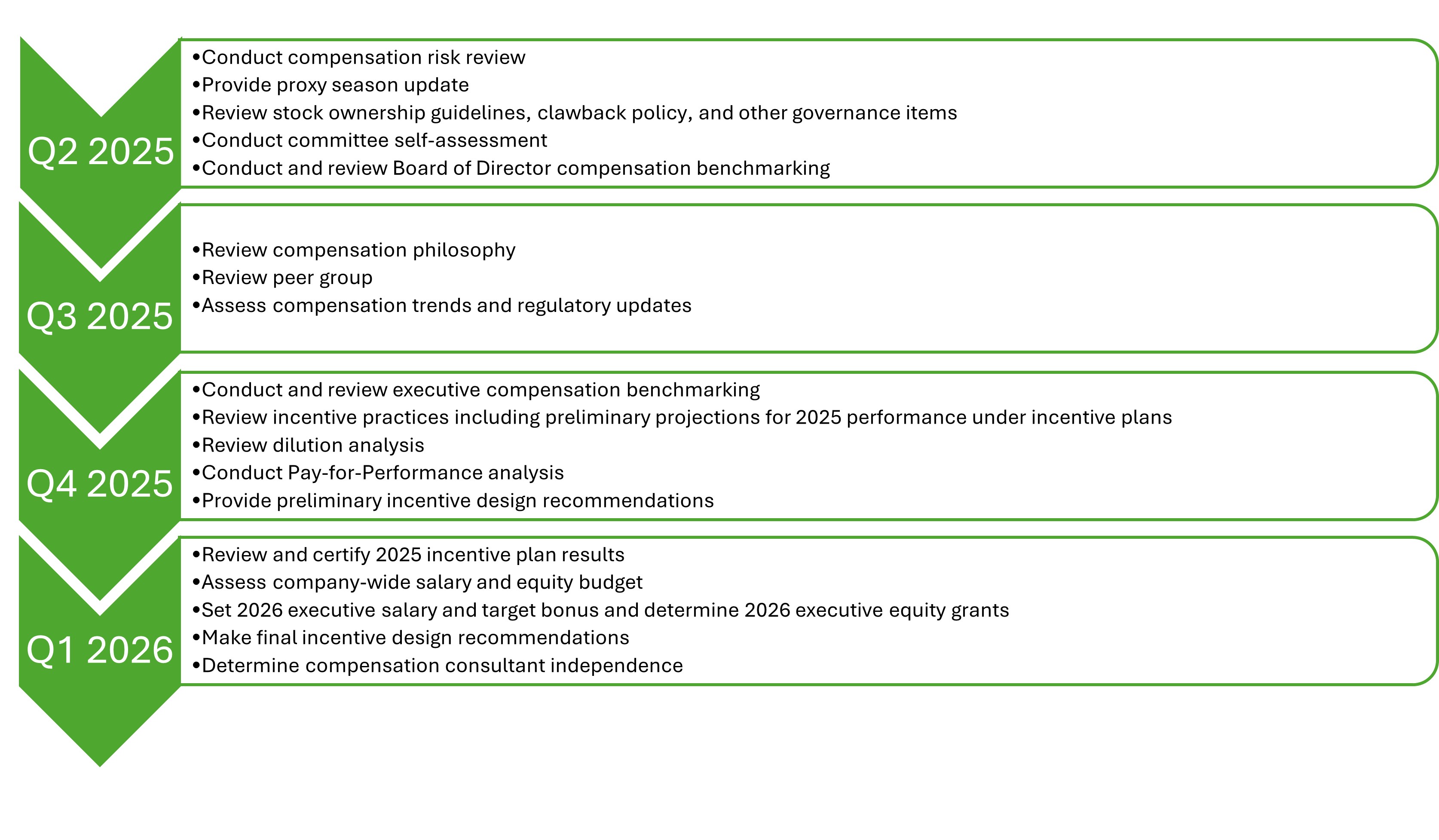
Role of Compensation Consultant
In 2025, the Compensation Committee engaged two independent compensation consultants. Frederick W. Cook & Co., Inc. (“FW Cook”) served as our consultant from January through May, providing counsel on compensation-related matters, including peer group selection and competitive market assessment. Beginning June 1, Mercer (US) Inc. (“Mercer”) took over as our independent compensation consultant, advising on market insights, trends in executive compensation, and executive officer compensation decisions. Throughout 2025, both consultants attended Committee and Board meetings, including executive sessions, and provided compensation advice independent of the Company’s management. Neither consultant engaged in other work for the Company. The Compensation Committee assessed the independence of both FW Cook and Mercer in accordance with SEC rules and concluded that their work did not raise any conflicts of interest.
Peer Group
The Compensation Committee uses peer groups and compensation surveys to maintain awareness of peer pay levels and ensure market competitiveness. Peer groups are regularly evaluated with regard to size, industry, and overall makeup.
The Compensation Committee, with assistance from its independent compensation consultant, annually reviews the composition of our peer group. As part of such reviews, the Compensation Committee considers specific criteria and recommendations regarding companies to add to or remove from the peer group. The review process is consistent with best practice, where potential peers are identified using objective screening criteria, input is provided by management, and the Compensation Committee uses its judgment to arrive at a reasonable sample.
35
2025 Peer Group Determination
The following factors were considered when selecting our peer group for 2025:
| Category | Criteria | ||||
| General | •Publicly traded, standalone companies •Comprehensive disclosure of executive compensation levels and practices | ||||
| Industry/Business Focus | •Focus on security, sensing, and AI technology companies, with a secondary focus on other technology companies | ||||
| Size | •Revenue and last fiscal year average market capitalization between 0.2x to 5.0x of Evolv | ||||
| Other | •Peers disclosed by Evolv’s continuing peer companies •Inclusion in ISS and Glass Lewis pay for performance peer groups | ||||
Based on these criteria, in July 2024, the Compensation Committee, in consultation with its then-independent compensation consultant, FW Cook, identified the following companies for its 2025 peer group(1):
| 908 Devices | Mitek Systems | Red Violet | ||||||
| CEVA | Napco Security | Sound Thinking | ||||||
| Digimarc | nLIGHT | SoundHound AI | ||||||
| FARO Technologies, Inc. | OneSpan Inc. | Terran Orbital | ||||||
| Immersion | Ouster | |||||||
| Luna Innovations | PDF Solutions | |||||||
(1)Among this peer group, Evolv placed in a near-median size range, with 35th percentile revenue and median market capitalization. One-year revenue growth was in the top quartile, while employee headcount was below median.
The following changes were made between the fiscal year 2024 and 2025 peer groups:
a.Seven companies were removed due to acquisition (Everbridge) or size criteria (AeroVironment, Digi, Rapid7, Qualys, SiTime, Workiva), on account of narrowing the size range used in selection criteria
b.Five companies were added. All of the five were determined to be relevant companies with security, sensing, and/or AI businesses: OneSpan, Red Violet, Digimarc (each of which produce automatic identification and security software and/or hardware), FARO Technologies (software-driven imaging and laser scanning hardware), SoundHound AI (custom AI and machine learning solutions)
2026 Peer Group Determination
In July 2025, during its normal review process and in consultation with Mercer its independent compensation consultant, the Compensation Committee determined the peer group companies to be used for fiscal year 2026 compensation decisions.
For the fiscal year 2026 peer group, the Compensation Committee modified the peer group by removing four peers. Terran Orbital was acquired, Luna Innovations was delisted, nLIGHT had limited disclosure as well as business model differences, and Digimarc was removed in part due to investor feedback. Though not removed from the list, we will monitor FARO Technologies for potential future exclusion, pending its acquisition.
In addition, three peers, all of which are relevant companies with security, sensing, and/or AI businesses, were added: Arlo Technologies (smart home security), BK Technologies (emergency communications; public safety radios), and Lantronix (IoT products and services). Within the resulting 16-company 2026 peer group, Evolv was at the 38th percentile on revenue and 73rd percentile on market capitalization at the time of the review.
In addition, the Compensation Committee introduced a reference peer group for 2026, identifying six companies with relevant business models whose size renders them too large for benchmarking pay levels. As such, these companies will provide supplemental market reference for pay and incentive practices but not pay
36
levels explicitly. These companies are: Motorola Solutions, Axon Enterprise, OSI Systems, AeroVironment, Alarm.com, and Clear Secure.
Additional Information
Compensation Recovery Policy
We previously adopted a compensation recovery policy (the “Clawback Policy”), effective as of October 2, 2023, to comply with final SEC and Nasdaq rules that require the clawback by us of certain incentive-based compensation paid to current and former executive officers in the event that we are required to prepare an accounting restatement.
In January 2025, the Board approved a new Executive Officer Compensation Recovery Policy, which has a broader scope and triggering criteria than the Clawback Policy. In addition to providing for the recovery of erroneously awarded incentive-based compensation received by current or former executive officers as required by SEC and Nasdaq rules, the Executive Officer Compensation Recovery Policy also provides for the clawback by us of all forms of cash and equity incentive compensation, whether time-based or performance-based, in the event of (i) a miscalculation that results in an overpayment of incentive compensation, which is not related to a restatement, or (ii) “misconduct,” either by a covered person or where the covered person was aware of or willfully blind to misconduct that occurred in an area over which the covered person had supervisory authority. The Board also approved a separate compensation recovery policy applicable to Senior Vice Presidents and Vice Presidents, which allows for the discretionary clawback of incentive compensation in the circumstances described above.
Policies and Practices Related to the Timing of Grants of Certain Equity Awards
37
EXECUTIVE COMPENSATION TABLES
Summary Compensation Table
The following table presents information regarding the total compensation for the years ended December 31, 2025 and 2024 of our named executive officers:
Name and Principal Position(1) | Year | Salary ($) | Stock Awards ($)(2) | Non-Equity Incentive Plan Compensation ($)(3) | All Other Compensation ($)(4) | Total ($) | |||||||||||||||||
John Kedzierski(5) Chief Executive Officer and President | 2025 | 540,001 | 6,054,750 | 796,500 | 76,608 | 7,467,859 | |||||||||||||||||
| 2024 | 20,769 | — | — | — | 20,769 | ||||||||||||||||||
Chris Kutsor Chief Financial Officer | 2025 | 284,423 | 3,499,995 | 318,161 | 52,317 | 4,154,896 | |||||||||||||||||
Robert Marshall Chief Revenue Officer | 2025 | 338,943 | 2,699,996 | 503,116 | 5,192 | 3,547,247 | |||||||||||||||||
___________________
(1)Messrs. Kutsor and Marshall became named executive officers in this proxy; accordingly, compensation information has only been provided for the fiscal year ended December 31, 2025.
(2)Amounts reflect the full grant-date fair value of MSUs and RSUs granted during 2025, computed in accordance with FASB ASC Topic 718, rather than the amounts paid to or realized by the named individual. The grant-date fair value of RSUs was calculated by multiplying the number of RSUs by the stock price on the date of grant. The grant date fair value of MSUs was estimated based on a Monte Carlo simulation model. We provide information regarding the assumptions used to calculate these values in Notes 2 and 15 to the consolidated financial statements included in our Annual Report on Form 10-K for the fiscal year ended December 31, 2025.
(3)Amounts reported as “Non-Equity Incentive Plan Compensation” represent awards earned under our Short-Term Annual Cash Incentive Plan based on pre-established performance criteria.
(4)Amounts represent 401(k) matching contributions, and travel stipends attributable to the NEOs, valued at the incremental cost to the Company of providing them. For Mr. Kedzierski, this amount represents $70,616 in travel stipends, paid pursuant to his offer letter which provides for a monthly travel stipend of $6,000 during the first year of employment and $3,000 during the second year of employment to assist with travel and housing costs associated with commuting to the Company's headquarters, and $5,992 in 401(k) matching contributions in 2025; for Mr. Kutsor, this amount represents $47,077 in travel stipend paid pursuant to his offer letter and $5,240 in 401(k) matching contributions in 2025; and for Mr. Marshall, this amount represents $5,192 in 401(k) matching contributions in 2025.
(5)Mr. Kedzierski joined the Company in December 2024 and received a pro-rated portion of his annual base salary equal to $20,769 for the 2024 fiscal year and his new hire RSUs and MSUs in January 2025.
Narrative Disclosure to Summary Compensation Table
Employment Arrangements. Each of our NEOs is employed on an at-will basis pursuant to an offer letter that sets forth the material terms of his compensation arrangement, including base salary, target annual bonus opportunity, initial equity awards, and, in the case of Mr. Kedzierski and Mr. Kutsor, a monthly travel stipend. Mr. Kedzierski’s offer letter was entered into in connection with his appointment as Chief Executive Officer and President in December 2024. Mr. Kutsor’s and Mr. Marshall’s offer letters were entered into in connection with their respective appointments as Chief Financial Officer and Chief Revenue Officer in 2025. The material terms of each NEO’s compensation are described in the sections above and in the footnotes to the Summary Compensation Table.
Annual Incentive Plan. Each NEO participates in our Short-Term Annual Cash Incentive Plan, under which target bonus opportunities are expressed as a percentage of base salary. For fiscal year 2025, annual incentive payouts were determined based on the Company's achievement against pre-established financial performance goals for revenue, free cash flow, and Adjusted EBITDA, as described in “Components of 2025 Executive Compensation Program — Short-Term Annual Cash Incentive Plan” above.
38
Equity Awards. In 2025, each NEO received initial equity grants consisting of RSUs and MSUs under the Company's 2021 Incentive Award Plan. RSU awards vest over a three-year period with one-third vesting on each anniversary of the grant date, subject to continued service. MSU awards vest based on the achievement of specified Company stock price goals over a three-year performance period, subject to continued employment through the applicable vesting or certification date. Equity grants are made in accordance with the Company's equity grant timing policy, as described in “Policies and Practices Related to the Timing of Grants of Certain Equity Awards” above.
Outstanding Equity Awards at 2025 Fiscal Year-End
The following table shows all outstanding equity awards held by the named executive officers as of December 31, 2025:
Stock Awards | ||||||||||||||||||||
| Name | Grant Date | Number of Shares or Units of Stock That Have Not Vested (#) | Market Value of Shares or Units of Stock That Have Not Vested ($)(1) | Equity Incentive Plan Awards: Number of Unearned Shares, Units or Other Rights That Have Not Vested (#) | Equity Incentive Plan Awards: Market or Payout Value of Unearned Shares, Units or Other Rights That Have Not Vested ($)(1) | |||||||||||||||
John Kedzierski | 1/2/2025 | (2) | 621,000 | $ | 4,446,360 | — | $ | — | ||||||||||||
| 1/2/2025 | (3) | — | $ | — | 621,000 | $ | 4,446,360 | |||||||||||||
| Chris Kutsor | 5/1/2025 | (2) | 416,666 | $ | 2,983,329 | — | $ | — | ||||||||||||
| 5/1/2025 | (3) | — | $ | — | 299,145 | $ | 2,141,878 | |||||||||||||
Robert Marshall | 3/3/2025 | (2) | 409,090 | $ | 2,929,084 | — | $ | — | ||||||||||||
| 3/3/2025 | (3) | — | $ | — | 306,818 | $ | 2,196,817 | |||||||||||||
___________________
(1)Based on the closing price of our Class A common stock of $7.16 per share as of December 31, 2025.
(2)The RSU awards vest over a three-year period with one-third vesting on the first, second, and third anniversaries of the vesting commencement date, subject to the recipient continuously providing services to us through each such vesting date.
(3)The MSU awards vest based on the achievement of specified Company stock price goals over a three-year performance period, subject to recipient’s continued employment with the Company through the applicable vesting or certification date. Pursuant to SEC rules, the number of shares and the payout value for the MSUs reflect payout at target because the Company’s stock price performance as measured through the end of the first year of the three-year performance period exceeded threshold levels but not target levels.
39
Pay Versus Performance
As a smaller reporting company, the Company is providing Pay Versus Performance disclosure in accordance with the scaled requirements of Item 402(v)(8) of Regulation S-K. Accordingly, the table below covers three fiscal years (rather than five), does not include peer group cumulative total shareholder return, does not include a Company-Selected Measure column, and does not include a Tabular List of financial performance measures. The Company is providing this disclosure for the second time in this proxy statement and, accordingly, footnote disclosure of the amounts deducted and added to calculate compensation actually paid is provided for each of the periods presented in the table.
The table below shows compensation actually paid (as defined by the SEC in Item 402(v) of Regulation S-K) for our executives and our financial performance for the years shown in the table. For purposes of this discussion, our CEO is also referred to as our principal executive officer (“PEO”) and our other named executive officers are referred to as our (“Non-PEO NEOs”):
| Year | SCT Total: PEO 11,2 | CAP: PEO 11,3 | SCT Total: PEO 21,2 | CAP: PEO 21,3 | SCT Total: PEO 31,2 | CAP: PEO 31,3 | Average SCT Total for Non-PEO NEOs1,2 | Average CAP to Non-PEO NEOs1,3 | Total Stockholder Return4 | Net Income (millions)5 | ||||||||||||||||||||||||||||||||||||||||||||||||||||
| 2025 | $ | $ | $ | 0 | $ | 0 | $ | 0 | $ | 0 | $ | $ | $ | $ | ( | |||||||||||||||||||||||||||||||||||||||||||||||
| 2024 | $ | $ | $ | $ | $ | $ | ( | $ | $ | ( | $ | $ | ( | |||||||||||||||||||||||||||||||||||||||||||||||||
| 2023 | $ | — | $ | — | $ | — | $ | — | $ | $ | $ | $ | $ | $ | ( | |||||||||||||||||||||||||||||||||||||||||||||||
(1)NEOs included in these columns reflect the following individuals:
| Year | PEO | Non-PEO NEOs | ||||||||||||
| 2025 | Chris Kutsor, Robert Marshall | |||||||||||||
| 2024 | Anil Chitkara, Mark Donohue, Jay Muelhoefer, | |||||||||||||
| 2023 | Mark Donohue, Jay Muelhoefer | |||||||||||||
(2)Amounts reflect Summary Compensation Table (“SCT”) Total Pay for our NEOs for each corresponding year.
(3)Compensation Actually Paid (“CAP”) has been calculated based on the requirements and methodology set forth in the applicable SEC rules (Item 402(v) of Regulation S-K). The CAP calculation includes the end-of-year value of awards granted within the fiscal year, the change in fair value from prior year end of vested awards and the change in the fair value of unvested awards granted in prior years, regardless of if, when, or at which intrinsic value they will actually vest. To calculate CAP for the fiscal year ended December 31, 2025, the amounts shown in the tables below were deducted from and added to the total compensation number shown in the SCT. Please refer to our Proxy Statement that was filed on April 30, 2025 in connection with our 2025 Annual Meeting of Stockholders for information regarding how CAP was calculated for the fiscal years ended December 31, 2024 and December 31, 2023
40
| Reconciliation of SCT Total to CAP for PEO 1 | Fiscal Year 2025 | ||||
Summary Compensation Table Total(A) | $ | ||||
(Minus): Grant Date Fair Value of Equity Awards Granted in the Fiscal Year | ( | ||||
Plus: Fair Value at Fiscal Year End of Outstanding and Unvested Equity Awards Granted in the Fiscal Year | |||||
Plus/(Minus): Change in Fair Value of Outstanding and Unvested Equity Awards Granted in Prior Fiscal Years | |||||
Plus: Fair Value at Vesting of Equity Awards Granted and Vested in the Fiscal Year | |||||
Plus/(Minus): Change in Fair Value as of the Vesting Date of Equity Awards Granted in Prior Fiscal Years that Vested in the Fiscal Year | |||||
(Minus): Fair Value as of the Prior Fiscal Year End of Equity Awards Granted in Prior Fiscal Years that Failed to Meet Vesting Conditions in the Fiscal Year | |||||
Plus: Value of Dividends or Other Earnings Paid on Equity Awards Not Otherwise Reflected in Total Compensation | |||||
| Compensation Actually Paid | $ | ||||
No amounts were paid to PEO 2 and PEO 3 in 2025 as neither served as PEO during the year ended December 31, 2025.
| Reconciliation of SCT Total to CAP for Non-PEO NEOs | Fiscal Year 2025 | ||||
| Summary Compensation Table Total | $ | ||||
(Minus): Grant Date Fair Value of Equity Awards Granted in Fiscal Year | ( | ||||
Plus: Fair Value at Fiscal Year End of Outstanding and Unvested Equity Awards Granted in the Fiscal Year | |||||
Plus/(Minus): Change in Fair Value of Outstanding and Unvested Equity Awards Granted in Prior Fiscal Years | |||||
Plus: Fair Value at Vesting of Equity Awards Granted and Vested in the Fiscal Year | |||||
Plus/(Minus): Change in Fair Value as of the Vesting Date of Equity Awards Granted in Prior Fiscal Years that Vested in the Fiscal Year | |||||
(Minus): Fair Value as of the Prior Fiscal Year End of Equity Awards Granted in Prior Fiscal Years that Failed to Meet Vesting Conditions in the Fiscal Year | |||||
Plus: Value of Dividends or Other Earnings Paid on Equity Awards Not Otherwise Reflected in Total Compensation | |||||
| Compensation Actually Paid | $ | ||||
For purposes of the above adjustments, the fair value of equity awards on the applicable date were determined in accordance with FASB’s ASC Topic 718, using valuation methodologies that are generally consistent with those used to determine the grant-date fair value for accounting purposes.
The assumptions used in calculating the fair value of the equity awards did not differ in any material respect from the assumptions used to calculate the grant date fair value of the awards as reported in the Summary Compensation Table.
(4)Total Stockholder Return (TSR) represents the cumulative return on a fixed investment of $100 in the Company’s common stock, for the period beginning on December 31, 2022 through the end of the applicable fiscal year, assuming reinvestment of dividends.
(5)The dollar amounts reported represent the net income reflected in the Company’s audited financial statements for the applicable year.
41
Cumulative TSR Calculation Summary
Value of Initial Fixed $100 Investment Based On: | |||||
Date | EVLV's TSR | ||||
12/31/2025 | $ | ||||
12/31/2024 | $ | ||||
12/31/2023 | $ | ||||
Relationship between CAP vs. Total Stockholder Returns
The following chart illustrates the relationship between CAP for our PEO and the average CAP for our Non-PEO NEOs against the Company’s total stockholder return:
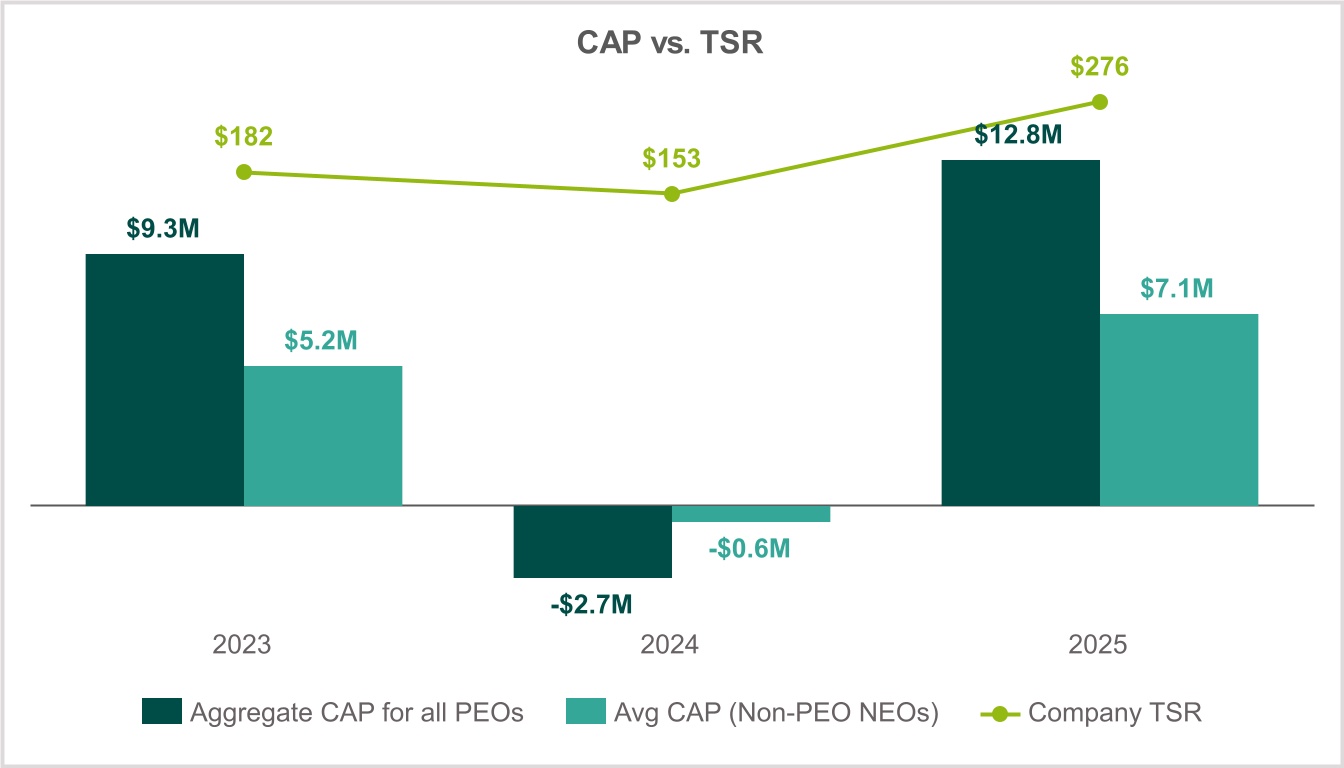
42
Relationship between CAP vs. Net Income
The following chart illustrates the relationship between CAP for our PEO and the average CAP for our Non-PEO NEOs against the Company’s net income:
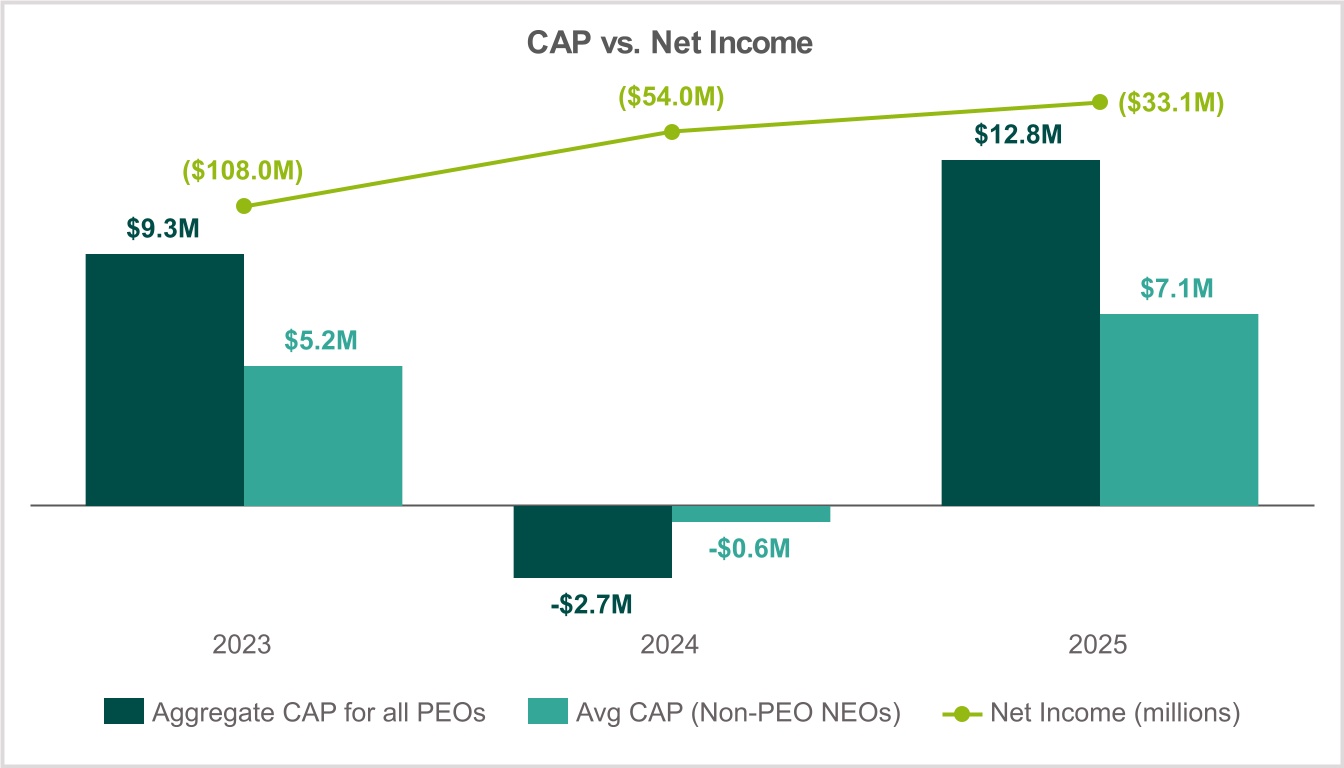
43
PROPOSAL 3: RATIFICATION OF APPOINTMENT OF INDEPENDENT REGISTERED PUBLIC ACCOUNTING FIRM
Our Audit Committee has appointed PricewaterhouseCoopers LLP (“PwC”) as our independent registered public accounting firm for the fiscal year ending December 31, 2026. Our Board has directed that this appointment be submitted to our stockholders for ratification at the Annual Meeting. Although ratification of our appointment of PwC is not required, we value the opinions of our stockholders and believe that stockholder ratification of our appointment is a good corporate governance practice.
While PwC has been retained as the Company’s independent registered public accounting firm continuously since 2015, in accordance with SEC rules and PwC policies, the firm’s lead engagement partner rotates every five years. Neither PwC nor any of its members has any direct or indirect financial interest in or any connection with us in any capacity other than as our auditors, providing audit and non-audit services. A representative of PwC is expected to attend the 2026 Annual Meeting and be available to respond to appropriate questions from stockholders.
In the event that the appointment of PwC is not ratified by the stockholders, the Audit Committee will consider this fact when it appoints the independent auditors for the fiscal year ending December 31, 2027. Even if the appointment of PwC is ratified, the Audit Committee retains the discretion to appoint a different independent auditor at any time if it determines that such a change is in the interest of the Company.
Recommendation of the Board of Directors
| The Board of Directors unanimously recommends a vote FOR the Ratification of the Appointment of PwC as our Independent Registered Public Accounting Firm for the fiscal year ending December 31, 2026. | ||||
Independent Registered Public Accounting Firm Fees and Other Matters
The following table summarizes the fees of PwC, our independent registered public accounting firm, billed to us for each of the last two fiscal years for audit services and billed to us in each of the last two fiscal years for other services:
| Fee Category | 2025 | 2024 | ||||||||||||
| Audit Fees | (1) | $ | 2,593,278 | $ | 6,009,787 | |||||||||
| Audit-Related Fees | — | — | ||||||||||||
Tax Fees | — | — | ||||||||||||
| All Other Fees | (2) | 2,000 | 2,000 | |||||||||||
| Total Fees | $ | 2,595,278 | $ | 6,011,787 | ||||||||||
___________________
(1)Audit fees consist of fees for the audit of our financial statements included in our Annual Report on Form 10-K and the review of our interim financial statements included in our quarterly reports on Form 10-Q, fees for services related to internal control over financial statements, fees related to the restatement of our financial statements and the related investigation, and fees for services ordinarily performed by our independent registered public accounting firm in connection with regulatory filings, including auditor consents, as well as related out-of-pocket expenses. The audit fees for fiscal year 2024 includes an additional $307,536 related to audit services rendered in fiscal year 2024, reflecting the actual amount incurred.
(2)All other fees consist of fees for services other than those described above. This relates to a subscription to a disclosure checklist tool.
Audit Committee Pre-Approval Policy and Procedures
The Audit Committee has adopted a policy (the “Pre-Approval Policy”) that sets forth the procedures and conditions pursuant to which audit and non-audit services proposed to be performed by the independent auditor may be pre-approved. The Pre-Approval Policy generally provides that we will not engage PwC to render any audit, audit-related, tax or permissible non-audit service unless the service is either (i) explicitly approved by the Audit Committee (“specific pre-approval”) or (ii) entered into pursuant to the pre-approval policies and procedures described in the Pre-Approval Policy (“general pre-approval”).
44
Unless a type of service to be provided by PwC has received general pre-approval under the Pre-Approval Policy, it requires specific pre-approval by the Audit Committee or by a designated member of the Audit Committee to whom the committee has delegated the authority to grant pre-approvals. Any proposed services exceeding pre-approved cost levels or budgeted amounts will also require specific pre-approval. For both types of pre-approval, the Audit Committee will consider whether such services are consistent with the SEC’s rules on auditor independence.
The Audit Committee will also consider whether the independent auditor is best positioned to provide the most effective and efficient service, for reasons such as its familiarity with the Company’s business, people, culture, accounting systems, risk profile and other factors, and whether the service might enhance the Company’s ability to manage or control risk or improve audit quality. All such factors will be considered as a whole, and no one factor should necessarily be determinative.
On a periodic basis, the Audit Committee reviews and generally pre‑approves categories of services (and related fee levels or budgeted amounts) to be provided by PwC. Services within such categories may be performed without obtaining additional specific approval from the Audit Committee. The Audit Committee may revise the list of generally pre‑approved services from time to time. All services performed since the adoption of the pre‑approval policy were pre‑approved.
Report of the Audit Committee of the Board of Directors
The Audit Committee has reviewed the audited consolidated financial statements of Evolv Technologies Holdings, Inc. (the “Company”) for the fiscal year ended December 31, 2025 and has discussed these financial statements with management and the Company’s independent registered public accounting firm. The Audit Committee has also received from, and discussed with, the Company’s independent registered public accounting firm various communications that such independent registered public accounting firm is required to provide to the Audit Committee, including the matters required to be discussed by the applicable requirements of the Public Company Accounting Oversight Board (“PCAOB”) and the Securities and Exchange Commission.
The Company’s independent registered public accounting firm also provided the Audit Committee with all written disclosures and the letter required by PCAOB Rule 3526 (Communications with Audit Committees Concerning Independence) describing all relationships between the independent registered public accounting firm and the Company, including the disclosures required by the applicable requirements of the PCAOB regarding the independent registered public accounting firm’s communications with the Audit Committee concerning independence. In addition, the Audit Committee discussed with the independent registered public accounting firm its independence from the Company.
Based on its discussions with management and the independent registered public accounting firm, and its review of the representations and information provided by management and the independent registered public accounting firm, the Audit Committee recommended to the Board of Directors that the audited consolidated financial statements be included in the Company’s Annual Report on Form 10-K for the fiscal year ended December 31, 2025.
Kimberly Sheehy (Chair)
David Mounts-Gonzales
Henrik Kühl
Richard Shapiro
The material in this report is not “soliciting material,” is not deemed “filed” with the SEC and is not to be incorporated by reference in any filing of the Company under the Securities Act of 1933, as amended (the “Securities Act”), or the Securities Exchange Act of 1934, as amended (the “Exchange Act”), whether made before or after the date hereof and irrespective of any general incorporation language in any such filing.
45
SECURITY OWNERSHIP OF CERTAIN BENEFICIAL OWNERS AND MANAGEMENT
The following table sets forth certain information with respect to holdings of our Class A common stock by (i) stockholders who beneficially owned more than 5% of the outstanding shares of our Class A common stock, and (ii) each of our directors (which includes all nominees), (iii) each of our named executive officers, and (iv) all directors and executive officers as a group as of March 20, 2026, unless otherwise indicated.
The number of shares beneficially owned by each stockholder is determined under rules issued by the SEC. Under these rules, beneficial ownership includes any shares as to which a person has sole or shared voting power or investment power. Applicable percentage ownership is based on 179,355,563 shares of Class A common stock outstanding as of March 20, 2026. In computing the number of shares beneficially owned by a person and the percentage ownership of that person, shares of Class A common stock subject to options, or other rights held by such person that are currently exercisable or will become exercisable within 60 days of March 20, 2026 are considered outstanding, although these shares are not considered outstanding for purposes of computing the percentage ownership of any other person.
Unless otherwise indicated, the address of each beneficial owner listed below is 500 Totten Pond Road, 4th Floor, Waltham, Massachusetts 02451. We believe that, based on information provided to us, each of the stockholders listed below has sole voting and investment power with respect to the shares beneficially owned by the stockholder unless noted otherwise, subject to community property laws where applicable.
Percentage ownership of our voting securities is based on 179,355,563 shares of our Class A common stock issued and outstanding as of March 20, 2026.
Name and Address of Beneficial Owner (1) | Number of Shares of Class A Common Stock Beneficially Owned | Percentage of Outstanding Shares | ||||||||||||
| 5% Stockholders: | ||||||||||||||
The Vanguard Group | (2) | 11,981,998 | 6.7 | % | ||||||||||
| BlackRock, Inc. | (3) | 9,391,975 | 5.2 | % | ||||||||||
| Directors and Named Executive Officers: | ||||||||||||||
| Kevin Charlton | (4) | 391,041 | * | |||||||||||
| Anil Chitkara | (5) | 3,188,455 | 1.8 | % | ||||||||||
| Michael Ellenbogen | (6) | 4,557,005 | 2.5 | % | ||||||||||
| Neil Glat | (7) | 216,550 | * | |||||||||||
| David Mounts-Gonzales | (8) | 174,739 | * | |||||||||||
John Kedzierski | (9) | 148,678 | * | |||||||||||
| Henrik Kühl | — | * | ||||||||||||
Chris Kutsor | (10) | 138,888 | * | |||||||||||
Robert Marshall | (11) | 14,000 | * | |||||||||||
| Rajan Naik | — | * | ||||||||||||
Richard Shapiro | (12) | 167,715 | * | |||||||||||
| Kimberly Sheehy | (13) | 143,035 | * | |||||||||||
| Mark Sullivan | (14) | 496,496 | * | |||||||||||
Directors and executive officers as a group (13 individuals) | (15) | 9,636,602 | 5.2 | % | ||||||||||
___________________
*Less than 1%
(1)Unless otherwise noted, the business address of each of the following entities or individuals is 500 Totten Pond Road, 4th Floor, Waltham, MA 02451.
(2)Based on Schedule 13G/A filed with the SEC on October 30, 2025. The Vanguard Group has sole voting power over 0 shares of Class A common stock, shared voting power over 932,533 shares of Class A common stock, sole dispositive power over 10,926,997 shares of Class A common stock, and shared
46
dispositive power over 1,055,001 shares of Class A common stock. The address of The Vanguard Group is 100 Vanguard Blvd., Malvern, PA 19355. In a subsequent Schedule 13G/A filed on March 26, 2026, The Vanguard Group disclosed that, as a result of an internal realignment effective January 12, 2026, (i) it is no longer deemed to beneficially own shares held by various of its subsidiaries and/or divisions, and accordingly, it no longer beneficially owns shares of common stock of the Company directly, and (ii) going forward, subsidiaries and divisions of The Vanguard Group will report beneficial ownership separately (on a disaggregated basis).
(3)Based on Schedule 13G filed with the SEC on November 8, 2024. BlackRock, Inc. has sole voting power over 9,391,975 shares of Class A common stock and sole dispositive power over 9,391,975 shares of Class A common stock. The address of BlackRock, Inc. is 50 Hudson Yards, New York, NY 10001.
(4)Consists of 391,041 shares of Class A common stock held by Mr. Charlton.
(5)Consists of (i) 1,348,651 shares of Class A common stock and (ii) 1,839,804 shares of Class A common stock subject to options that are exercisable within 60 days of March 20, 2026 held by Mr. Chitkara.
(6)Based on Schedule 13D filed with the SEC on January 30, 2023 and other information known to the Company, consists of (i) 2,083,961 shares of Class A common stock held directly by Mr. Ellenbogen, (ii) 151,135 shares of Class A common stock held by a trust over which Mr. Ellenbogen may be deemed to have shared voting and dispositive power and (iii) 2,321,909 shares of Class A common stock subject to options held by Mr. Ellenbogen that are exercisable within 60 days of March 20, 2026.
(7)Consists of (i) 216,550 shares of Class A common stock held by Mr. Glat.
(8)Consists of (i) 174,739 shares of Class A common stock held by Mr. Mounts-Gonzales.
(9)Consists of (i) 148,678 shares of Class A common stock held by Mr. Kedzierski.
(10)Consists of (i) 138,888 shares of Class A common stock underlying RSUs held by Mr. Kutsor that will vest within 60 days of March 20, 2026.
(11)Consists of (i) 14,000 shares of Class A common stock held by Mr. Marshall.
(12)Consists of (i) 167,715 shares of Class A common stock held by Mr. Shapiro.
(13)Consists of (i) 143,035 shares of Class A common stock held by Ms. Sheehy.
(14)Consists of (i) 215,578 shares of Class A common stock and (ii) 280,918 shares of Class A common stock subject to options held by Mr. Sullivan that are exercisable within 60 days of March 20, 2026.
(15)Consists of (i) 5,055,083 shares of Class A common stock held by all directors and executive officers of Evolv as a group, (ii) 4,442,631 shares of Class A common stock subject to options held by all directors and executive officers of Evolv as a group and that are exercisable within 60 days of March 20, 2026 and (iii) 138,888 shares of Class A common stock underlying RSUs held by all directors and executive officers of Evolv as a group that will vest within 60 days of March 20, 2026.
DELINQUENT SECTION 16(a) REPORTS
Section 16(a) of the Exchange Act requires our executive officers and directors, our principal accounting officer and persons who beneficially own more than 10% of our Class A common stock to file with the SEC reports of their ownership and changes in their ownership of our Class A common stock. To our knowledge, based solely on review of the copies of such reports and amendments to such reports with respect to the year ended December 31, 2025 filed with the SEC and on written representations by our directors and executive officers, all required Section 16 reports under the Exchange Act for our directors, executive officers, principal accounting officer and beneficial owners of greater than 10% of our Class A common stock were filed on a timely basis during the year ended December 31, 2025, other than one late Form 4 for Robert Marshall reporting one transaction.
47
CERTAIN RELATIONSHIPS AND RELATED PERSON TRANSACTIONS
Our Board adopted a related person transaction policy that sets forth our procedures for the identification, review, consideration and approval or ratification of related person transactions. Under the policy, our legal team is primarily responsible for developing and implementing processes and procedures to obtain information regarding related persons with respect to potential related person transactions and then determining, based on the facts and circumstances, whether such potential related person transactions do, in fact, constitute related person transactions requiring compliance with our policy. A related person transaction is a transaction, arrangement or relationship, or any series of similar transactions, arrangements or relationships, in which the Company and any related person are, were, or will be participants and in which the amount involved exceeds $120,000. Pursuant to the policy, transactions involving compensation for services provided to the Company as an employee or director have been pre-approved by the Audit Committee. A related person is any executive officer, director, or beneficial owner of more than 5% of any class of our voting securities and any of their respective immediate family members and any entity owned or controlled by such persons.
Under the policy, if a transaction has been identified as a related person transaction, including any transaction that was not a related person transaction when originally consummated or any transaction that was not initially identified as a related person transaction prior to consummation, our management must present information regarding the related person transaction to the Audit Committee, for review, consideration and approval or ratification. The presentation must include a description of, among other things, all relevant facts and circumstances relating thereto. Under the policy, the Company will collect information that we deem reasonably necessary from each director, executive officer and, to the extent feasible, significant stockholder to enable the Company to identify any existing or potential related-person transactions and to effectuate the terms of the policy. In considering related person transactions, the Company’s Audit Committee will take into account the relevant available facts and circumstances including, but not limited to:
•whether the transaction is on terms comparable to those that could be obtained in arm’s length dealings with an unrelated third party;
•the extent of the related person’s interest in the transaction; and the conflicts of interest and corporate opportunity provisions of the Company’s Code of Business Conduct and Ethics. The policy requires that, in determining whether to approve, ratify or reject a related person transaction, Evolv’s Audit Committee must consider, in light of known circumstances, whether the transaction is in, or is not inconsistent with, the Company’s best interests and those of the Company’s stockholders, as the Company’s Audit Committee, or other independent body of Company’s Board, determines in the good faith exercise of its discretion.
The following are certain transactions, arrangements and relationships with our directors, executive officers, and stockholders owning 5% or more of our outstanding Class A common stock, or any member of the immediate family of any of the foregoing persons, in which the amount involved exceeded or will exceed $120,000, since January 1, 2025, other than equity and other compensation, termination, change in control, and other arrangements, which are described under “Executive Compensation”. We believe that the terms of such agreements are as favorable as those we could have obtained from parties not related to us.
Relationships and Transactions with Directors, Executive Officers and Significant Stockholders
On July 16, 2021, we consummated the business combination (the “Merger” or the “Business Combination”) contemplated by the Agreement and Plan of Merger, as amended on March 5, 2021 (the “Merger Agreement”), with NHIC Sub Inc. (“Merger Sub”), a wholly-owned subsidiary of NewHold Investment Corp. (“NHIC”), which is our legal predecessor, and Evolv Technologies, Inc. dba Evolv Technology, Inc. (“Legacy Evolv”). Pursuant to the Merger Agreement, Merger Sub was merged with and into Legacy Evolv, with Legacy Evolv surviving the Merger as a wholly owned subsidiary of the Company. Upon the closing of the Merger, we changed our name to Evolv Technologies Holdings, Inc. The following agreements remain material to the Company as of the publication of this proxy statement.
Amended and Restated Insider Letter Agreement. In connection with the “Merger Agreement”, NHIC, NewHold Industrial Technology Holdings LLC (the “Sponsor”), members of NHIC’s board of directors and certain other individuals (collectively, the “Insiders”) who held Class B common shares of NHIC (the “Founder Shares”) and Legacy Evolv entered into an amended and restated insider letter agreement (the “Letter Agreement”), which provided, among other things, that the Founder Shares (and any shares of NHIC common stock issuable upon conversion thereof) shall be subject to certain share-performance-based vesting provisions
48
described below. Fifty percent of the Founder Shares vested at the closing of the Business Combination, 25% of the Founder Shares shall vest on or before the fifth anniversary of the closing and no longer be subject to forfeiture if the closing share price of the common stock equals or exceeds $12.50 over any 20 trading days within a 30-day trading period and the remaining 25% will vest on or before the fifth anniversary of the closing and no longer be subject to forfeiture if the closing share price of the Class A common stock equals or exceeds $15.00 over any 20 trading days within any 30-day trading period. Further, the Sponsor and the Insiders have agreed, subject to exceptions, not to transfer any unvested Founder Shares prior to the date such securities become vested. The Letter Agreement also provides that neither the Sponsor nor the Insiders will redeem any shares of NHIC common stock owned by such persons in connection with the Business Combination. Neil Glat and Kevin Charlton are Insiders who hold Founder Shares.
Amended and Restated Registration Rights Agreement. In connection with the closing of the Business Combination, Legacy Evolv, NHIC and certain stockholders of each of Legacy Evolv and NHIC who received shares of common stock pursuant to the Merger Agreement, entered into an amended and restated registration rights agreement (“Registration Rights Agreement”). Pursuant to the Registration Rights Agreement, we agreed to file a shelf registration statement with respect to the registrable securities under the Registration Rights Agreement. Up to twice in any 12-month period, each of certain Legacy Evolv stockholders and NHIC stockholders may request to sell all or any portion of their registrable securities in an underwritten offering. We also agreed to provide customary “piggyback” registration rights. The Registration Rights Agreement also provides that we will pay certain expenses relating to such registrations and indemnify the stockholders against certain liabilities. Neil Glat, Anil Chitkara, and Kevin Charlton are parties to the Registration Rights Agreement.
QUESTIONS AND ANSWERS ABOUT THE 2026 ANNUAL MEETING OF STOCKHOLDERS
Who is entitled to vote at the Annual Meeting?
The Record Date for the Annual Meeting is April 24, 2026. You are entitled to vote at the Annual Meeting only if you were a stockholder of record at the close of business on that date, or if you hold a valid proxy for the Annual Meeting. Each outstanding share of Class A common stock is entitled to one vote for all matters before the Annual Meeting. At the close of business on the Record Date, there were 179,617,902 shares of Class A common stock outstanding and entitled to vote at the Annual Meeting.
What is the difference between being a “record holder” and holding shares in “street name”?
A record holder holds shares in his or her name. Shares held in “street name” means shares that are held in the name of a bank or broker on a person’s behalf.
Am I entitled to vote if my shares are held in “street name”?
Yes. If your shares are held by a bank or a brokerage firm, you are considered the “beneficial owner” of those shares held in “street name.” If your shares are held in street name, these proxy materials are being provided to you by your bank or brokerage firm, along with a voting instruction card if you received printed copies of our proxy materials. As the beneficial owner, you have the right to direct your bank or brokerage firm how to vote your shares, and the bank or brokerage firm is required to vote your shares in accordance with your instructions. If your shares are held in street name, you may not vote your shares online at the Annual Meeting, unless you obtain a legal proxy from your bank or brokerage firm.
How many shares must be present to hold the Annual Meeting?
A quorum must be present at the Annual Meeting for any business to be conducted. The presence at the Annual Meeting online or by proxy, of the holders of a majority in voting power of the Class A common stock issued and outstanding and entitled to vote, present in person, or by remote communication, if applicable, or represented by proxy, on the Record Date will constitute a quorum.
Who can attend the Annual Meeting?
Evolv has decided to hold the Annual Meeting entirely online this year to allow greater participation. You may attend the Annual Meeting online only if you are an Evolv stockholder who is entitled to vote at the Annual
49
Meeting, or if you hold a valid proxy for the Annual Meeting. You may attend and participate in the Annual Meeting by visiting the following website:
www.virtualshareholdermeeting.com/EVLV2026
To attend and participate in the Annual Meeting, you will need the 16-digit control number included in your Internet Notice, on your proxy card or on the instructions that accompanied your proxy materials. If your shares are held in “street name,” you should contact your bank or broker to obtain your 16-digit control number or otherwise vote through the bank or broker. If you lose your 16-digit control number, you may join the Annual Meeting as a “Guest” but you will not be able to vote, ask questions or access the list of stockholders as of the Record Date. The meeting webcast will begin promptly at 10:00 a.m. eastern time. We encourage you to access the meeting prior to the start time. Online check-in will begin at 9:55 a.m., eastern time, and you should allow ample time for the check-in procedures.
What if a quorum is not present at the Annual Meeting?
If a quorum is not present at the scheduled time of the Annual Meeting, the Chairperson of the Annual Meeting is authorized by our Amended and Restated Bylaws to adjourn the meeting, without the vote of stockholders.
What does it mean if I receive more than one Internet Notice or more than one set of proxy materials?
It means that your shares are held in more than one account at the transfer agent and/or with banks or brokers. Please vote all of your shares. To ensure that all of your shares are voted, for each Internet Notice or set of proxy materials, please submit your proxy by phone, via the Internet, or, if you received printed copies of the proxy materials, by signing, dating and returning the enclosed proxy card in the enclosed envelope.
How do I vote?
Stockholders of Record. If you are a stockholder of record, you may vote by:
•Internet (including by scanning your QR code on your Notice and/or Proxy Card with your mobile device) — You can vote over the Internet at www.virtualshareholdermeeting.com/EVLV2026 by following the instructions on the Internet Notice or proxy card;
•Telephone — You can vote by telephone by calling 1-866-894-0536. Use a touch-tone telephone to vote your proxy. Have your proxy card available when you call. Follow the voting instructions to vote your shares.
•Mail — You can vote by mail by signing, dating and mailing the proxy card, which you may have received by mail; or
•Electronically at the Meeting — If you attend the meeting online, you will need the 16-digit control number included in your Internet Notice, on your proxy card or on the instructions that accompanied your proxy materials to vote electronically during the meeting.
Internet and telephone voting facilities for stockholders of record will be available 24 hours a day and will close at 11:59 p.m., eastern time, on June 17, 2026. To participate in the Annual Meeting, including to vote via the Internet or telephone, you will need the 16-digit control number included on your Internet Notice, on your proxy card or on the instructions that accompanied your proxy materials.
Whether or not you expect to attend the Annual Meeting online, we urge you to vote your shares as promptly as possible to ensure your representation and the presence of a quorum at the Annual Meeting. If you submit your proxy, you may still decide to attend the Annual Meeting and vote your shares electronically.
Beneficial Owners of Shares Held in “Street Name.” If your shares are held in “street name” through a bank or broker, you will receive instructions on how to vote from the bank or broker. You must follow their instructions in order for your shares to be voted. Internet and telephone voting also may be offered to stockholders owning shares through certain banks and brokers. If your shares are not registered in your own name and you would like to vote your shares online at the Annual Meeting, you should contact your bank or broker to obtain your 16-digit control number or otherwise vote through the bank or broker. If you lose your 16-digit control number, you may join the Annual Meeting as a “Guest” but you will not be able to vote, ask questions or access the list of stockholders as of the Record Date. You will need to obtain your own Internet access if you choose to attend the Annual Meeting online and/or vote over the Internet.
50
Can I change my vote after I submit my proxy?
Yes.
If you are a registered stockholder, you may revoke your proxy and change your vote:
•by submitting a duly executed proxy bearing a later date;
•by granting a subsequent proxy through the Internet or telephone;
•by giving written notice of revocation to the Secretary of Evolv prior to or at the Annual Meeting; or
•by voting online at the Annual Meeting.
Your most recent proxy card or Internet or telephone proxy is the one that is counted. Your attendance at the Annual Meeting by itself will not revoke your proxy unless you give written notice of revocation to the Secretary before your proxy is voted or you vote online at the Annual Meeting.
If you are a beneficial owner and your shares are held in street name, you may change or revoke your voting instructions by following the specific directions provided to you by your bank or broker, or you may vote online at the Annual Meeting by obtaining your 16-digit control number or otherwise voting through the bank or broker.
Who will count the votes?
A representative of Broadridge Financial Solutions, Inc., our inspector of election, will tabulate and certify the votes.
What if I do not specify how my shares are to be voted?
If you submit a proxy but do not indicate any voting instructions on the Company’s proxy card, the persons named as proxies will vote in accordance with the recommendations of the Board. Proxies cannot be voted for a greater number of persons than the number of nominees named in Proposal 1. The Board’s recommendations are indicated on page 4 of this proxy statement, as well as with the description of each proposal in this proxy statement.
Will any other business be conducted at the Annual Meeting?
We know of no other business that will be presented at the Annual Meeting. If any other matter properly comes before the stockholders for a vote at the Annual Meeting, however, the proxy holders named on the Company’s proxy card will vote your shares in accordance with their best judgment.
Why hold a virtual meeting?
We believe that hosting a virtual meeting this year is in the best interest of the Company and its stockholders. A virtual meeting also enables increased stockholder attendance and participation because stockholders can participate from any location around the world. A virtual meeting can also provide cost savings for our stockholders and us, and it is more environmentally friendly.
You will be able to attend the Annual Meeting online and submit your questions by visiting
www.virtualshareholdermeeting.com/EVLV2026. You also will be able to vote your shares electronically at the Annual Meeting by following the instructions above.
What if during the check-in time or during the Annual Meeting I have technical difficulties or trouble accessing the virtual meeting website?
We will have technicians ready to assist you with any technical difficulties you may have accessing the virtual meeting website. Information for assistance can be found at www.virtualshareholdermeeting.com/EVLV2026.
Will there be a question-and-answer session during the Annual Meeting?
As part of the Annual Meeting, we will hold a live Q&A session, during which we intend to answer questions submitted online during the meeting that are pertinent to the Company and the meeting matters, after the
51
completion of the Annual Meeting. Appropriate questions submitted by stockholders will be read during the Q&A session of the Annual Meeting. Only stockholders that have accessed the Annual Meeting as a stockholder (rather than a “Guest”) by following the procedures outlined above in “Who can attend the Annual Meeting?” will be permitted to submit questions during the Annual Meeting.
Information regarding the Q&A session will be available in the “Rules of Conduct” available on the Annual Meeting webpage for stockholders that have accessed the Annual Meeting as a stockholder (rather than a “Guest”) by following the procedures outlined above in “Who can attend the Annual Meeting?”
What are the proposals to be voted on and how many votes are required for approving each proposal?
| Proposal | Votes required | Effect of Votes Withheld / Abstentions and Broker Non-Votes | ||||||||||||
Proposal 1: Election of Class II Directors | The plurality of the votes cast. This means that the two nominees receiving the highest number of affirmative “FOR” votes will be elected as Class II Directors. | Votes withheld and broker non-votes will have no effect. | ||||||||||||
Proposal 2: Approval of, on an advisory (non-binding) basis, the Say-on-Pay Vote | The affirmative vote of the holders of a majority in voting power of the votes cast (excluding abstentions and broker non-votes) on such matter. | Abstentions and broker non-votes will have no effect. | ||||||||||||
Proposal 3: Ratification of Appointment of Independent Registered Public Accounting Firm | The affirmative vote of the holders of a majority in voting power of the votes cast (excluding abstentions and broker non-votes) on such matter. | Abstentions and broker non-votes will have no effect. We do not expect any broker non-votes on this proposal. | ||||||||||||
What is a “vote withheld” and an “abstention” and how will votes withheld and abstentions be treated?
A “vote withheld,” in the case of Proposal 1, or an “abstention,” in the case of Proposal 2,and Proposal 3 represent a stockholder’s affirmative choice to decline to vote on a proposal. Votes withheld and abstentions are counted as present and entitled to vote solely for purposes of determining a quorum. Votes withheld will have no effect on the election of directors and abstentions will have no effect on the approval on an advisory (non-binding) basis of the compensation of our named executive officers or the ratification of the appointment of PwC.
What are broker non-votes and do they count for determining a quorum?
Generally, broker non-votes occur when shares held by a broker in “street name” for a beneficial owner are not voted with respect to a particular proposal because the broker (1) has not received voting instructions from the beneficial owner and (2) lacks discretionary voting power to vote those shares. A broker is entitled to vote shares held for a beneficial owner on routine matters, without instructions from the beneficial owner of those shares. The only routine matter presented at the Annual Meeting is Proposal 3, relating to the ratification of the appointment of PwC as our independent registered public accounting firm for the year ending December 31, 2026. On the other hand, absent instructions from the beneficial owner of such shares, a broker is not entitled to vote shares held for a beneficial owner on non-routine matters, such as the election of directors, or approval on an advisory (non-binding) basis of the compensation of our named executive officers. Broker non-votes count for purposes of determining whether a quorum is present.
What happens if a nominee for director should become unable to serve, or for good cause will not serve?
If that happens, the persons named as proxies may vote for a substitute nominee designated by the Board to fill the vacancy, or, if no substitute has been nominated, for the remaining nominees, leaving a vacancy, or the Board may reduce its size. The Board has no reason to believe that any of the nominees will be unable or decline to serve if elected.
52
Where can I find the voting results of the Annual Meeting?
We plan to announce preliminary voting results at the Annual Meeting and we will report the final results in a Current Report on Form 8-K, which we intend to file with the SEC within four business days following the Annual Meeting.
INFORMATION ABOUT THIS PROXY STATEMENT
Why you received this proxy statement. You are viewing or have received these proxy materials because Evolv’s Board is soliciting your proxy to vote your shares at the Annual Meeting. This proxy statement includes information that we are required to provide to you under the rules of the SEC and that is designed to assist you in voting your shares.
Notice of Internet Availability of Proxy Materials. As permitted by SEC rules, Evolv is making this proxy statement and its 2025 Annual Report available to its stockholders electronically via the Internet. On or about April 30, 2026, we mailed to our stockholders a Notice of Internet Availability of Proxy Materials (the “Internet Notice”) containing instructions on how to access this proxy statement and our 2025 Annual Report and vote online. If you received an Internet Notice by mail, you will not receive a printed copy of the proxy materials in the mail unless you specifically request them. Instead, the Internet Notice instructs you on how to access and review all of the important information contained in the proxy statement and 2025 Annual Report. The Internet Notice also instructs you on how you may submit your proxy over the Internet. If you received an Internet Notice by mail and would like to receive a printed copy of our proxy materials, you should follow the instructions for requesting such materials contained on the Internet Notice.
Printed Copies of Our Proxy Materials. If you received printed copies of our proxy materials, then instructions regarding how you can vote are contained on the proxy card included in the materials.
Householding. The SEC’s rules permit us and intermediaries (e.g., brokers, banks, and other agents) to deliver a single set of proxy materials to one address shared by two or more of our stockholders. This delivery method is referred to as “householding” and can result in significant cost savings. To take advantage of this opportunity, we and a number of intermediaries with account holders who are our stockholders have delivered only one set of proxy materials to multiple stockholders who share an address, unless we received contrary instructions from the impacted stockholders prior to the mailing date. A proxy card or voting instruction form will be delivered for each of the stockholders sharing an address. We agree to deliver promptly, upon written or oral request, a separate copy of the proxy materials, as requested, to any stockholder at the shared address to which a single copy of those documents was delivered. If you prefer to receive separate copies of the proxy materials or if you are currently a stockholder sharing an address with another stockholder and wish to receive only one copy of future proxy materials for your household, please contact Broadridge, either by calling (800) 579-1639 or by writing to 51 Mercedes Way, Edgewood, NY 11717.
STOCKHOLDERS’ PROPOSALS
Stockholders who intend to have a proposal considered for inclusion in our proxy materials for presentation at our 2027 Annual Meeting pursuant to Rule 14a-8 under the Exchange Act must submit the proposal to our Secretary at our offices at 500 Totten Pond Road, 4th Floor, Waltham, Massachusetts 02451 in writing not later than December 31, 2026 (which is 120 days prior to April 30, 2027, the one-year anniversary of the mailing of the Company’s 2026 definitive proxy statement).
Stockholders intending to present a proposal at the 2027 Annual Meeting, but not to include the proposal in our proxy statement, or to nominate a person for election as a director, must comply with the requirements set forth in our Amended and Restated Bylaws. Our Amended and Restated Bylaws require, among other things, that our Secretary receive written notice from the stockholder of record of their intent to present such proposal or nomination not more than the 120th day and not less than the 90th day prior to the anniversary of the preceding year’s annual meeting. Therefore, we must receive notice of such a proposal or nomination for the 2027 Annual Meeting no earlier than February 18, 2027 and no later than March 20, 2027. In the event that the date of the 2027 Annual Meeting is more than 30 days before or more than 60 days after June 18, 2027, then our Secretary must receive such written notice not more than the 120th day prior to the 2027 Annual Meeting and not later than the 90th day prior to the 2027 Annual Meeting or, if later, the 10th day following the day on which public disclosure of the date of such meeting is first made by us.
53
In addition to satisfying the foregoing requirements under our Amended and Restated Bylaws, to comply with the universal proxy rules, stockholders who intend to solicit proxies in support of director nominees other than our nominees must also comply with the requirements of Rule 14a-19 under the Exchange Act.
We reserve the right to reject, rule out of order, or take other appropriate action with respect to any proposal that does not comply with these or other applicable requirements.
OTHER MATTERS
Our Board is not aware of any matter to be presented for action at the Annual Meeting other than the matters referred to above and does not intend to bring any other matters before the Annual Meeting. However, if other matters should come before the Annual Meeting, it is intended that holders of the proxies named on the Company’s proxy card will vote thereon in their discretion.
Solicitation of Proxies
Our Board is soliciting proxies for the Annual Meeting. We will bear the expense of preparing, printing, and mailing this proxy statement and the proxies we solicit. Proxies will be solicited by mail, telephone, personal contact, and electronic means and may also be solicited by directors, officers, and employees in person, by the Internet, by telephone, or by facsimile transmission, without additional remuneration for their services. We have retained D.F. King to act as a proxy solicitor in conjunction with the Annual Meeting. We have agreed to pay D.F. King $15,000, plus reasonable out-of-pocket expenses, for proxy solicitation services.
We also will request brokerage firms, banks, nominees, custodians, and fiduciaries to forward proxy materials to the beneficial owners of shares of our stock as of the record date and will reimburse them for the cost of forwarding the proxy materials in accordance with customary practice.
Your cooperation in promptly voting your shares and submitting your proxy by Internet or telephone, or by completing and returning the enclosed proxy card (if you received your proxy materials in the mail), will help to avoid additional expense.
Note About Forward Looking Statements and Other Disclaimers
This proxy statement contains forward-looking statements within the meaning of the Private Securities Litigation Reform Act of 1995. We intend such forward-looking statements to be covered by the safe harbor provisions for forward-looking statements contained in Section 27A of the Securities Act of 1933, as amended (the “Securities Act”), and Section 21E of the Securities Exchange Act of 1934, as amended (the “Exchange Act”). All statements contained in this proxy statement, other than statements of historical fact, including, without limitation, statements regarding our business strategy, the markets in which we operate, consumer demand, our future financial and operational results, our ability to obtain new customers and retain existing customers, corporate governance efforts, changes to our executive compensation program, and our stockholder engagement efforts and commitments, are forward-looking statements. The words “may,” “will,” “should,” “expects,” “plans,” “anticipates,” “could,” “intends,” “targets,” “projects,” “contemplates,” “believes,” “estimates,” “forecasts,” “predicts,” “potential” or “continue” or the negative of these terms or other similar expressions are intended to identify forward-looking statements though not all forward-looking statements use these word or expressions. The forward-looking statements in this proxy statement are only predictions. We have based these forward-looking statements largely on our current expectations and projections about future events and financial trends that we believe may affect our business, financial condition and results of operations. Forward-looking statements involve known and unknown risks, uncertainties and other important factors that may cause our actual results, performance or achievements to be materially different from any future results, performance or achievements expressed or implied by the forward-looking statements, including, without limitation the important factors discussed in Part I, Item 1A, “Risk Factors” in our most recent Annual Report on Form 10-K, as any such factors may be updated from time to time in its other filings with the SEC. The forward-looking statements in this proxy statement are based upon information available to us as of the date of this proxy statement, and while we believe such information forms a reasonable basis for such statements, it may be limited or incomplete, and our statements should not be read to indicate that we have conducted an exhaustive inquiry into, or review of, all potentially available relevant information. These statements are inherently uncertain and investors are cautioned not to unduly rely upon these statements.
The content of the websites referred to in this proxy statement are provided for convenience only. Information from such websites is not incorporated by reference into this proxy statement.
54
Evolv’s Annual Report on Form 10-K
A copy of Evolv’s Annual Report on Form 10-K for the fiscal year ended December 31, 2025, including financial statements and schedules thereto but not including exhibits, as filed with the SEC, will be sent to any stockholder of record on April 24, 2026 without charge upon written request addressed to:
Evolv Technologies Holdings, Inc.
Attention: Secretary
500 Totten Pond Road, 4th Floor
Waltham, Massachusetts 02451
A reasonable fee will be charged for copies of exhibits. You also may access this proxy statement and our Annual Report on Form 10-K at www.virtualshareholdermeeting.com/EVLV2026. You also may access our Annual Report on Form 10-K for the fiscal year ended December 31, 2025 at www.evolvtechnology.com.
WHETHER OR NOT YOU PLAN TO ATTEND THE ANNUAL MEETING ONLINE, WE URGE YOU TO VOTE YOUR SHARES VIA THE TOLL-FREE TELEPHONE NUMBER OR OVER THE INTERNET, AS DESCRIBED IN THIS PROXY STATEMENT. IF YOU RECEIVED A COPY OF THE PROXY CARD BY MAIL, YOU MAY SIGN, DATE AND MAIL THE PROXY CARD IN THE ENCLOSED RETURN ENVELOPE. PROMPTLY VOTING YOUR SHARES WILL ENSURE THE PRESENCE OF A QUORUM AT THE ANNUAL MEETING AND WILL SAVE US THE EXPENSE OF FURTHER SOLICITATION.
By Order of the Board of Directors
Rachel Roy, General Counsel and Secretary
Waltham, Massachusetts
April 30, 2026
55
APPENDIX A NON-GAAP RECONCILIATION AND KEY PERFORMANCE INDICATOR INFORMATION
Non-GAAP Reconciliation
This Proxy Statement contains Adjusted EBITDA and free cash flow, financial measures which are not based on any standardized methodology prescribed by GAAP.
Adjusted EBITDA
We use Adjusted EBITDA to evaluate our operating results and for financial and operational decision-making purposes, which is why we present this information to investors. Adjusted EBITDA is defined as net income (loss) plus depreciation and amortization, stock-based compensation, interest expense (income), provision for income taxes, change in fair value of contingent earn-out liability, change in fair value of contingently issuable/returnable common stock liability/asset, change in fair value of public warrant liability, loss on impairment of leased equipment, loss on impairment of intangible asset, loss on disposal of leased equipment, non-recurring employee restructuring and other separation costs, non-recurring inventory charges, and other non-recurring legal and regulatory costs.
Below is a reconciliation of GAAP Net Loss, the most directly comparable GAAP financial measure, to Adjusted EBITDA (unaudited, in thousands):
| Twelve Months Ended December 31, | |||||||||||
| 2025 | 2024 | ||||||||||
Net loss | $ | (33,138) | $ | (54,017) | |||||||
| Depreciation and amortization | 24,340 | 17,375 | |||||||||
| Stock-based compensation | 21,096 | 24,756 | |||||||||
| Interest expense (income) | 196 | (2,942) | |||||||||
| Provision for income taxes | 62 | — | |||||||||
| Change in fair value of contingent earn-out liability | (12,435) | (16,310) | |||||||||
| Change in fair value of contingently issuable/returnable common stock liability/asset | (2,614) | (2,529) | |||||||||
| Change in fair value of public warrant liability | (435) | (6,592) | |||||||||
| Loss on impairment of leased equipment | — | 224 | |||||||||
| Loss on impairment of intangible asset | — | 983 | |||||||||
| Loss on disposal of leased equipment | 3,787 | — | |||||||||
| Non-recurring employee restructuring and other separation costs | 2,976 | 3,060 | |||||||||
| Non-recurring inventory charges | — | 2,730 | |||||||||
| Other non-recurring legal and regulatory costs | 7,279 | 12,284 | |||||||||
| Adjusted EBITDA | $ | 11,114 | $ | (20,978) | |||||||
Free Cash Flow
We use free cash flow for purposes of the Company's 2025 annual incentive bonus program. Free cash flow is defined as the quarterly average of cash flows from operating activities, plus capitalized internal-use software development costs and excluding cash flows from inventory and the accretion of discount on marketable securities, net of accrued interest. We believe free cash flow is an important indicator of financial performance as it measures our ability to fund the business.
Below is a reconciliation of net cash used in operating activities, the most directly comparable GAAP financial measure, to free cash flow (unaudited, in thousands):
56
| Twelve Months Ended December 31, | |||||
| 2025 | |||||
Net cash provided by operating activities | $ | 18,669 | |||
Plus: capitalized internal-use software development costs | (5,627) | ||||
Excluding: Cashflows from inventory | (9,118) | ||||
Excluding: Accretion of discount on marketable securities, net of change in accrued interest | 126 | ||||
Adjusted cash flows | 4,050 | ||||
Free cash flow | $ | 1,013 | |||
Annual Recurring Revenue
We believe annual recurring revenue (“ARR”) is a useful metric for investors because it provides visibility into the scale and sustainability of our recurring revenue base. ARR reflects the annualized value of active subscription arrangements at a point in time and helps investors evaluate trends in customer and unit acquisition, retention, and expansion. As our business continues to shift toward pure subscription and purchase subscription sales models (and away from our legacy distribution subscription model), we believe ARR more accurately captures the recurring nature of our revenue compared to period based revenue measures alone. Management also uses ARR to assess operating performance, inform strategic decisions, and plan for future growth, because it is impacted by multiple dimensions of our business, including new customer and unit acquisition, customer pricing, renewal history, and renewal pricing. We define ARR as subscription revenue and the recurring service revenue related to purchase subscriptions for the final month of the quarter normalized to a one-year period. Our calculation of ARR is not adjusted for the impact of any known or projected future events (such as customer cancellations, upgrades or downgrades, or price increases or decreases) that may cause any such contract not to be renewed on its existing terms. In addition, the amount of actual revenue that we recognize over any 12-month period is likely to differ from ARR at the beginning of that period, sometimes significantly. This may occur due to new bookings, cancellations, upgrades, downgrades or other changes in pending renewals, as well as the effects of professional services revenue and acquisitions or divestitures. As a result, ARR should be viewed independently of, and not as a substitute for or forecast of, revenue and deferred revenue. Our calculation of ARR may differ from similarly titled metrics presented by other companies.
57